

Buy Vitamin E Capsules Online in Kenya – Quest Vitamin E 400 IU
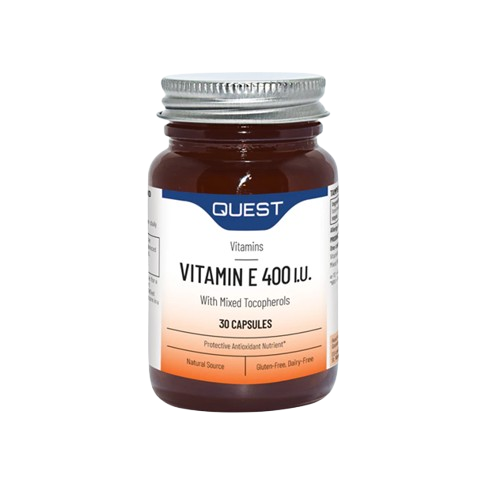
Quest Vitamin E 400 IU is a pack of thirty natural-source vitamin E capsules, each supplying d-alpha tocopherol with mixed tocopherols in sunflower seed oil, taken once daily with food.
Most people buy vitamin E for their heart, their skin or their fertility, and those are the three places the evidence is weakest. It is worth taking if a doctor has asked you to, or as a low-risk part of a fertility plan you are already following with one. One capsule with a meal, because it is fat-soluble and food is what gets it absorbed. If you take warfarin, aspirin or fish oil, or you have surgery or a dental extraction coming, speak to our pharmacist before you start.
The Heart Claim on the Old Listing Does Not Survive the Evidence
The question has been tested properly, more than once, at exactly this dose. The largest trial gave four hundred international units a day to thousands of people already at high cardiovascular risk and followed them for seven years. It found no reduction in heart attacks, strokes or cardiovascular death — and a small but statistically significant increase in heart failure. Later trials in healthy doctors and in healthy women found the same absence of benefit.
So a heart-health label on this product is not a harmless piece of marketing. It aims the claim at precisely the people the evidence suggests should be most careful with it.
What Four Hundred Units a Day Actually Does
Vitamin E is a fat-soluble antioxidant: it sits in cell membranes and protects the fats in them from oxidation, and that part is not in dispute. What is in dispute is whether supplementing above dietary levels changes any outcome that matters. Two further findings are worth knowing before you buy. A prevention trial in more than thirty thousand healthy men found a seventeen per cent higher rate of prostate cancer in the group taking four hundred units daily — a small absolute difference, under two extra cases per thousand men a year, but a real one. And high-dose vitamin E thins the blood slightly, which is the practical concern for most people.
Keep both in proportion. This dose sits well below the recognised upper safe intake for adults, so it is not a toxic dose and the product is legitimate. And the prostate trial used the synthetic form, while this is the natural one, which nobody has tested the same way — so the finding may or may not transfer. We would rather you had both halves of that.
The Fertility Question, Answered Straight
This is the commonest reason men buy it in Kenya, and the old listing promised sperm motility outright. The honest position: the research on antioxidants in male subfertility is of low quality, the trials are small, and where vitamin E appears to help it is usually given with selenium or other antioxidants rather than alone. Nobody has convincingly shown that vitamin E by itself produces more pregnancies. It is cheap and well tolerated, so it is a reasonable thing to include in a plan — it is not a treatment.
What actually moves sperm quality: stopping smoking; cutting alcohol; losing excess weight; keeping the scrotum cool, which means no laptop on the lap and no long hot baths; and treating a varicocele or an infection, both common and both fixable. A semen analysis costs less than three months of capsules and tells you something. Get one first.
Who Should Genuinely Take Vitamin E Capsules
There is a clear group, and it is not the one the old listing was written for. The strongest case is a medical one: people who cannot absorb fat properly, because vitamin E travels with dietary fat. That includes cystic fibrosis, Crohn’s disease, chronic pancreatitis, cholestatic liver disease and some post-surgical states. There deficiency is real, it causes nerve damage over time, and supplementing is genuinely necessary. If a doctor has told you to take vitamin E, take it.
The reasonable case is the fertility one above, as one low-risk part of a plan you are already following. And if you want an antioxidant top-up and understand it is not treating anything, that is your decision to make with the facts in front of you. If it is your skin you are thinking of, see the skin question below — the short answer is that daily sunscreen does more than either the capsule or the cream.
Vitamin E Deficiency Is Rare Here, and the Reason Is in Your Cooking Oil
Dietary vitamin E deficiency is almost unknown in people who absorb fat normally, and that is truer here than in many places. The richest everyday sources are vegetable oils — sunflower above all — and Kenyan cooking uses a great deal of it. Add groundnuts, avocado, sunflower seeds and the dark leafy greens in sukuma wiki and managu, and an ordinary diet here covers the requirement several times over. So this is a top-up far above dietary need, not the correction of a shortage you are likely to have.
The One-Letter Test on the Label
A test you can do in the shop, at no cost, on any vitamin E product for the rest of your life. Look for d-alpha tocopherol, not dl-alpha tocopherol. The extra letter is the whole difference. The d- form is natural, extracted from vegetable oil; the dl- form is synthetic and your body uses it roughly half as efficiently, which is why the international unit is defined differently for the two. This product is the d- form, stated on the label.
So two products showing the same strength can be quite different things, and the cheaper one is usually the dl- form. Read the ingredients rather than the front of the box. It is the only quality test in this category that costs nothing.
What Is in It
Worth reading, because the old listing advertised what this product is free from without mentioning two things it contains.
- D-alpha tocopheryl — the natural vitamin E, four hundred international units per capsule
- Mixed tocopherols — beta, gamma and delta forms alongside the alpha, derived from soya
- Sunflower seed oil — the carrier, and the reason a capsule is taken with food
- Gelatin capsule shell, bovine — so this is not vegetarian, not vegan, and not certified halal unless the carton says so
- Free from dairy, gluten and nuts
The two that matter are the ones the marketing left out. Soya is a common allergen, and a product advertised as allergen-free is exactly where a careful label-reader stops checking. The bovine shell rules it out for vegetarians and raises a question for anyone who eats halal. Ask and we will read you the carton before you pay.
How to Take Vitamin E Capsules, and What Not to Take Them With
One capsule daily, swallowed whole with a meal containing some fat — on an empty stomach much of it is wasted, so with lunch or supper rather than first thing. The interaction that matters is bleeding: high-dose vitamin E thins the blood mildly, which is harmless alone and less so in combination.
- Warfarin, aspirin or clopidogrel — do not start vitamin E without telling the doctor who prescribed them
- Fish oil and omega-3 — the same effect from a second direction, and we sell an omega-3 capsule
- Surgery, a dental extraction or a planned delivery — stop about two weeks beforehand and tell the surgeon or dentist you have been taking it
- A multivitamin — most already contain vitamin E, so check before stacking. This is the commonest accidental double dose we see
Bring us your current medicines, or a photograph of the labels, and we will check the combination in two minutes — the reason to buy a supplement from a pharmacy rather than off a shelf.
Why Buy Your Vitamin E Capsules from HealthAlone Kenya?
HealthAlone is a pharmacist-led health ecosystem licensed by the Pharmacy and Poisons Board, and our stock is original, sealed and correctly stored. Vitamin E is an antioxidant, which means it is the thing in the capsule that oxidises first: heat and light degrade it, so a capsule that has sat in a hot store is worth less than the label says. Where it has been kept is part of what you buy.
We stock every alternative this page pointed you towards, so there was no commercial reason to talk you out of three of the usual reasons for buying it — beyond wanting you to buy the right thing.
We deliver across Kenya — Nairobi first, then Mombasa, Kisumu, Nakuru, Eldoret, Thika and beyond — and across East Africa to Tanzania and Uganda, with the wider African market where we are heading. Collect in person at Kahawa Sukari Shopping Center, Nairobi. Living abroad? Order online from the US or UK and we deliver to your family in Kenya.
It is one more step in our vision: building Africa’s most trusted health ecosystem, accessible to everyone, everywhere.
Frequently Asked Questions
Price in Kenya — how much is it, and how long does a pack last?
You will see the current price right on this page, always up to date. On the useful question: thirty capsules taken once daily is one month, so this is a monthly purchase if you stay on it. Before you commit to that, read the fertility and heart answers below, because for a good number of people the honest answer is that a second month is not worth buying.
Does vitamin E improve sperm motility?
The evidence is weak. The trials are small and of low quality, and where vitamin E appears to help it is usually given with selenium or other antioxidants rather than on its own. It is cheap and well tolerated, so it is a reasonable thing to include in a fertility plan, but it is not a treatment. Stopping smoking, cutting alcohol, losing excess weight, keeping the scrotum cool and treating a varicocele or infection all do more. Start with a semen analysis.
Is four hundred units a day safe?
It is below the recognised upper safe intake for adults, so it is not a toxic dose. Two findings are worth knowing anyway: a seven-year trial at this dose found an increase in heart failure in people already at high cardiovascular risk, and a large prevention trial found a seventeen per cent higher rate of prostate cancer in healthy men taking the synthetic form. Neither makes the product dangerous for most people. Both are reasons to take it for a reason rather than out of habit.
Will it help my heart?
On the best evidence, no. Trials at this dose in people at high cardiovascular risk, in healthy doctors and in healthy women all found no reduction in heart attacks, strokes or cardiovascular death, and the longest of them found more heart failure in the vitamin E group. If heart health is your reason for buying, a blood pressure check and a lipid profile are a far better use of the money.
Should I take the capsules or use a vitamin E cream for my skin?
Swallowing vitamin E has never been shown to do much for skin appearance. A cream at least puts it where the problem is, and we stock one. But the single most useful thing for skin in Kenya is daily broad-spectrum sunscreen, which prevents the damage the antioxidant is meant to mop up, costs less than either, and protects the results of everything else you use.
I take warfarin, aspirin or clopidogrel. Can I take this?
Not without telling the doctor who prescribed them. Vitamin E at this dose has a mild blood-thinning effect of its own, and added to a medicine that does the same it can push things further than intended. This is a conversation, not an outright no — but it is a conversation to have first. Bring us the labels and we will look at them with you.
Is it vegetarian or halal, and does it contain soya?
It is not vegetarian: the capsule shell is bovine gelatin. It is not certified halal unless the carton states so, and we will check the carton for you. And yes, it contains soya — the mixed tocopherols are soya-derived. That matters because the listing advertises it as dairy-free, gluten-free and nut-free, which is exactly the sort of claim that stops a careful label-reader from checking further.
Do I need it if I eat a normal Kenyan diet?
Almost certainly not. Vitamin E is abundant in vegetable oils, especially sunflower, and Kenyan cooking uses plenty of it. Groundnuts, avocado, sunflower seeds and dark leafy greens add more. Deficiency is essentially confined to people who cannot absorb fat properly, which is a diagnosed medical condition rather than something you would have without knowing.
Can I take it with my multivitamin or my fish oil?
Check the multivitamin label first, because most already contain vitamin E and the two together are the commonest accidental double dose we see. With fish oil, the issue is that both mildly thin the blood, so the combination is worth mentioning to us or to your doctor, particularly before any surgery or dental work.
Where can I buy vitamin E capsules in Kenya?
Order online from HealthAlone for delivery in Nairobi, Mombasa, Kisumu, Nakuru, Eldoret, Thika and beyond, and across East Africa to Tanzania and Uganda. You can also collect in person at Kahawa Sukari Shopping Center, Nairobi, where a pharmacist will read you the carton and check it against anything else you are taking before you pay.

