

Dyna Knee Immobiliser: Holds the Knee Straight So a Fracture, a Torn Ligament or an Operated Knee Can Knit
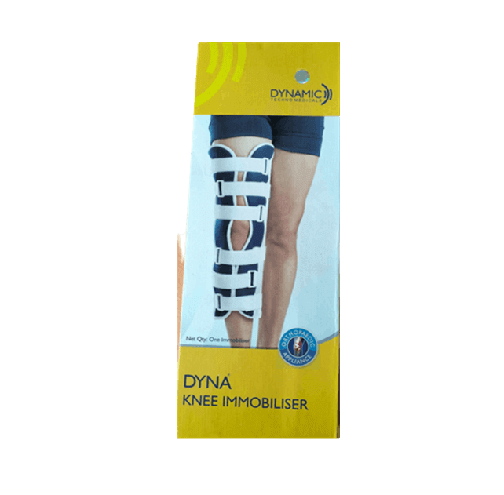
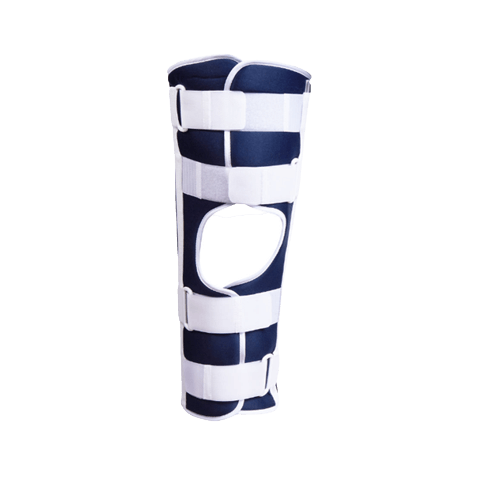
This Dyna knee immobiliser holds the knee straight and stops it bending, so a fractured kneecap, a torn ligament or a freshly operated knee is kept still while it knits. It is a long padded splint running from mid-thigh to mid-calf with rigid stays down each side, and it wraps round the leg and fastens with straps rather than being pulled on like a sleeve.
It is made by Dynamic Techno Medical and costs 3,000 shillings. This is the one product on this shelf meant to stop the knee moving rather than support it through movement, which makes it the one our doctor decides on rather than the shopper. The straps undo completely, so it goes on a leg that is painful and swollen without the leg having to bend at all, and it comes off for washing and for the exercises our doctor allows.
What It Is For
A fractured kneecap or a fracture around the knee, where the bone needs to be held in line while it heals.
A torn or repaired ligament in the first stage, before controlled bending is allowed.
The first days or weeks after knee surgery, on the surgeon’s instruction.
A dislocated kneecap that has been put back, while the tissue around it settles.
And getting somebody safely to hospital with a knee injury that needs the leg kept still on the way.
Putting It On Without Bending the Leg
Undo every strap and lay the splint open on the bed. Then slide the leg onto it rather than wrapping it round a leg held in the air.
Centre it on the knee. The middle of the splint sits level with the kneecap, with equal length above and below; the top edge should stop short of the groin and the bottom edge short of the ankle.
Check the stays lie flat down the sides of the leg and that none of them is digging into the back of the knee.
Fasten the middle straps first, then work outwards. Firm, with room for two fingers under each strap.
Then stand and walk a few steps, and re-tighten. The splint settles the moment the leg takes weight.
The Two Things That Go Wrong With an Immobilised Leg
The first is a clot in the leg. Keeping a leg still raises the risk of a deep vein thrombosis, and in trials of people with a lower leg immobilised, clots were found in between 4.3% and 40% of those given nothing to prevent them, with a blood-thinning injection roughly halving the odds. Our doctor will say whether you need one. Meanwhile, know the signs: calf pain, swelling, warmth or redness in that leg, and above all sudden breathlessness or chest pain, which means a hospital today.
The second is the thigh muscle melting away. In a study of healthy young men, one week of leg immobilisation cost 6.7% of the thigh muscle at the front of the leg, with most of that gone between day two and day seven. That muscle is what will hold your knee steady afterwards, so ask our doctor on day one which exercises you may do inside the splint — tightening the thigh, lifting the straight leg, moving the ankle — and do them.
Move the ankle and the toes hourly while you are awake, and keep the leg raised when you are resting. Both help with the clot risk and with swelling.
Skin, Washing and Wear
Look at the skin every day at the back of the knee, along both stays, at the top edge on the inner thigh and at the bottom edge. A red mark that stays red after you press it is the first sign of a pressure sore; loosen the fit and tell our doctor that day.
Press a toenail and watch the colour return. Pins and needles, numbness, a cold or bluish foot, or pain that climbs rather than settles mean the straps are too tight.
The pads come out for washing. Hand-wash them in cool water with mild soap and dry them flat away from heat. Wipe the stays rather than soaking them, and put the splint back on dry.
Wear it as long as our doctor says and no longer. The end date is part of the treatment rather than a matter of comfort, and coming out of it in stages is usually how it is done.
Getting About While You Are In It
You will need your hands free and a stable third point of contact. A pair of elbow crutches is the usual answer where you have been told to keep weight off the leg, and a walking stick in the hand opposite the splinted leg where partial weight is allowed.
When our doctor steps you down to controlled bending, a hinged knee brace is usually what comes next, because it holds the knee against sideways movement while letting it bend again.
Is a Knee Immobiliser Right for You?
This splint suits fractures around the knee, ligament injuries and post-operative knees where our doctor has asked for the joint to be held still. Please speak to our doctor before buying one if any of these apply:
- Nobody has examined the knee. An X-ray is called for if you are 55 or over, if the top of the shin bone on the outer side is tender, if the kneecap alone is tender, if the knee will bend no further than a right angle, or if you could not take four steps at the time of the injury and still cannot now. Please come to our doctor or go to a hospital today.
- What you have is an aching, arthritic or swollen knee. Keeping that knee moving is the better answer, and our pharmacist will point you to a support instead.
- There is numbness, pins and needles or weakness in the leg or the foot, or the foot is cold or discoloured. Go to a hospital today.
- The calf is painful, swollen or warm, or you are short of breath. Go to a hospital today.
- The skin over the leg is broken, infected or very fragile, or sensation in the leg is reduced, so pressure damage would go unnoticed.
Our pharmacists will measure the leg, size the splint and show you the daily skin checks, and our doctor will say how long it stays on and which exercises you may do inside it.
Where to Buy a knee immobiliser in Kenya
Order online and we deliver countrywide, or collect from our pharmacy at Kahawa Sukari Shopping Center, Nairobi. We send orders to Nairobi and every neighbourhood around it — the CBD, Westlands, Parklands, Gigiri, Muthaiga, Runda, Rosslyn, Kitisuru, Lower Kabete, Lavington, Kileleshwa, Kilimani, Karen, Langata, South B, South C, Eastleigh, Buruburu, Donholm, Embakasi, Ngong Road, Kasarani, Roysambu, Zimmerman, Githurai, Ruaka, Banana Hill, Two Rivers, Village Market and Pride Lands — and across Kiambu, Thika, Juja, Ruiru, Kikuyu, Limuru and Ngong.
Beyond the capital we deliver to Mombasa, Kisumu, Nakuru, Eldoret, Nyeri, Machakos, Athi River, Kitengela, Kajiado, Naivasha, Narok, Kericho, Bomet, Kisii, Migori, Homa Bay, Siaya, Bungoma, Busia, Kakamega, Vihiga, Webuye, Kitale, Nandi Hills, Iten, Kapenguria, Embu, Meru, Chuka, Kerugoya, Murang’a, Othaya, Nyahururu, Nanyuki, Maralal, Isiolo, Marsabit, Moyale, Wajir, Mandera, Garissa, Lodwar, Kitui, Mwingi, Makueni, Emali, Kibwezi, Voi, Taveta, Wundanyi, Mariakani, Diani, Ukunda, Kilifi, Watamu, Malindi, Lamu and Hola. Tell us the town and we will confirm the delivery cost and the timing before you pay.
Across Africa, ask us before you order. We have sent orders to Uganda, Tanzania, Somaliland and as far as Malawi, and we will quote for Rwanda, Burundi, South Sudan, Ethiopia, Zambia, Zimbabwe, Botswana, Mozambique, Nigeria, Ghana, South Africa and the rest of the continent. Tell us the destination and we will confirm any import paperwork before the parcel leaves us.
Living abroad? Order from wherever you are and we deliver here in Kenya. Kenyans in the UK, the United States, Canada, South Africa and the Gulf order from us regularly for a parent or relative at home, and this is one of the things they order most. Tell us the address and we will deliver and set it up.
Why Buy Your a knee immobiliser from HealthAlone Kenya?
HealthAlone is a pharmacist-led health ecosystem licensed by the Pharmacy and Poisons Board, and our stock is original, sealed and correctly stored. Kahawa Sukari is a real counter with real pharmacists behind it.
Our pharmacists measure the leg and size the splint before it leaves us, and our doctor is at the counter to examine a knee that has yet to be looked at and to say how long the splint stays on.
It is one more step in our vision: building Africa’s most trusted health ecosystem, accessible to everyone, everywhere.
FAQs
How do I know whether my knee needs an X-ray?
An X-ray is called for after a knee injury if any one of these applies: you are 55 or over; the top of the shin bone on the outer side of the knee is tender; the kneecap is tender on its own; you cannot bend the knee to a right angle; or you could not take four steps immediately after the injury and still cannot now. If any apply, please come to our doctor or go to a hospital today rather than buying a splint and waiting.
What is the difference between an immobiliser and a knee brace?
An immobiliser holds the knee straight and stops it bending at all. A brace holds the knee against sideways movement while letting it bend and straighten. The first is for a knee that must stay still while something knits; the second is for a knee that needs supporting through activity.
How long do I wear it?
As long as our doctor says, and the end date matters as much as the start. A knee held straight for weeks stiffens, and the thigh muscle wastes quickly: one week of leg immobilisation cost healthy young men 6.7% of the muscle at the front of the thigh. Our doctor will usually step you out of it in stages.
Is there a risk of a blood clot?
Keeping a leg still raises the risk of a clot in the deep veins. In trials of people with a lower leg immobilised, clots were found in between 4.3% and 40% of those given nothing to prevent them, and a blood-thinning injection roughly halved the odds. Ask our doctor whether you need one. Calf pain, swelling, warmth or redness in that leg, and above all sudden breathlessness or chest pain, mean a hospital today.
Can I do any exercise while I am in it?
Ask our doctor on the first day, because the answer is usually yes and it protects your thigh muscle. Tightening the thigh without moving the knee, lifting the whole straight leg, and circling the ankle are the three that are commonly allowed inside a splint. Move the ankle and toes hourly while you are awake.
Can I walk in it?
Only as far as our doctor allows, and never put full weight on a leg you have been told to keep weight off. Most people need elbow crutches alongside it, or a walking stick in the hand opposite the splinted leg where partial weight is permitted.
Can I sleep in it?
Usually yes, and our doctor will tell you. Keep the leg raised on a pillow, check the skin when it comes off in the morning, and loosen the straps a little at night so they are firm rather than tight.
How tight should the straps be?
Firm, with room to slide two fingers under each one. Press a toenail and watch the colour come back. Pins and needles, numbness, a cold or bluish foot, or pain that climbs rather than settles all mean it is too tight.
How do I put it on if the leg is too painful to lift?
Undo every strap and lay the splint open flat on the bed, then slide the leg onto it rather than wrapping it round a leg held in the air. Fasten the middle straps first and work outwards. That is why this fastens with straps instead of pulling on like a sleeve.
What size do I need?
Tell our pharmacist the distance from mid-thigh to mid-calf, and your thigh and calf measurements in centimetres. The splint should sit with its middle level with the kneecap, the top edge short of the groin and the bottom edge short of the ankle.
Can I wash it?
The pads come out. Hand-wash them in cool water with mild soap and dry them flat away from heat. Wipe the stays rather than soaking them, and put the splint back on only when it is fully dry.
My knee is just painful and swollen. Should I buy this?
Please talk to our pharmacist first. For an aching, arthritic or swollen knee, keeping the joint moving is the better answer and a knee support is the usual choice. This splint is for knees our doctor has asked to be held still.
What happens when I come out of it?
Our doctor will usually step you down to controlled bending in a hinged brace, then to a support, then to nothing, alongside exercises to rebuild the thigh. A physiotherapist is worth the visit and our pharmacist can point you to one.
Where can I buy a knee immobiliser in Kenya?
Order from HealthAlone online and we deliver countrywide, or collect from our pharmacy at Kahawa Sukari Shopping Center, Nairobi. We deliver across Nairobi — the CBD, Westlands, Parklands, Lavington, Kileleshwa, Kilimani, Karen, Langata, South B, South C, Eastleigh, Buruburu, Donholm, Embakasi, Kasarani, Roysambu, Zimmerman, Githurai and Ruaka — and across Kiambu, Thika, Juja, Ruiru, Kikuyu, Limuru and Ngong, as well as Mombasa, Kisumu, Nakuru, Eldoret, Nyeri, Machakos, Kitengela, Naivasha, Narok, Kericho, Kisii, Bungoma, Kakamega, Kitale, Embu, Meru, Chuka, Murang’a, Nyahururu, Nanyuki, Isiolo, Garissa, Lodwar, Kitui, Voi, Kilifi, Malindi and Diani. Send us the leg measurements and we will size it for you.
