


Dyna Hinged Knee Brace: Stops the Knee Buckling Sideways While You Keep Walking on It
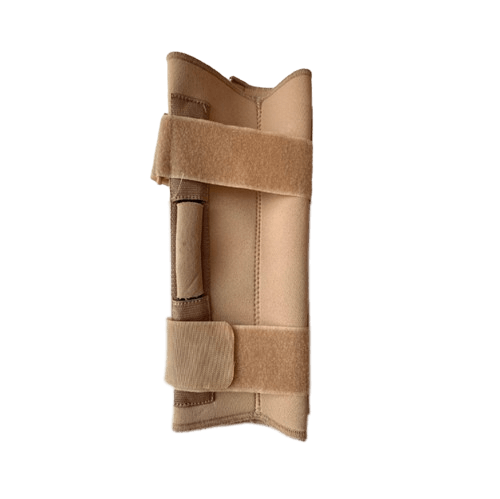
This Dyna hinged knee brace stops the knee giving way sideways, so a knee that has been sprained, has a ligament injury or has been operated on is held steady through the walking that heals it. Metal hinges sit on both sides of the joint, which is what allows the knee to bend and straighten freely while being held against the sideways movement that hurts.
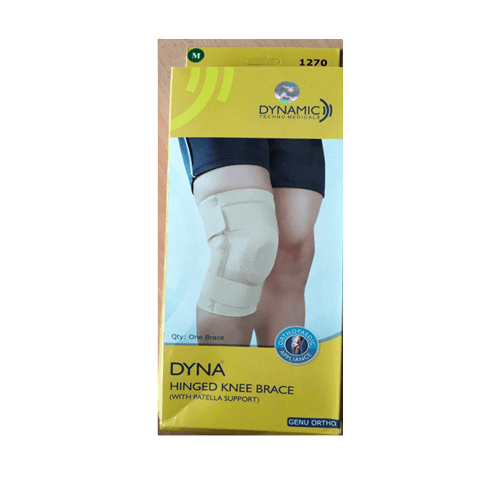
It is a Dynamic Techno Medical brace, the carton we hold carries the article number 1270 in size M, and at 3,440 shillings it sits between the elastic sleeves on this shelf and the rigid supports above it. The hinges are the reason for the difference in price: an elastic sleeve warms and compresses the joint, while a hinged brace adds a mechanical stop on each side. Our pharmacist takes the measurement around your knee and confirms the size before it leaves us.
What the Hinges Add Over a Plain Sleeve
They hold the knee against sideways force. The ligaments on the inside and outside of the knee are the ones that stop it folding inwards or outwards. When one has been strained, the hinges take that load while it heals.
They leave bending and straightening alone. You can walk normally, climb stairs and sit down. That matters, because the knee recovers through use rather than through rest, and a brace that let you keep moving is the point of buying this one over a splint.
They give the joint back its confidence. In a study of people with a knee that kept giving way, wearing a knee brace more than halved the odds of the knee feeling unstable while walking and more than halved the odds of lacking confidence in it, as well as easing pain and speeding up walking and getting out of a chair. That feeling of trusting the leg again is the thing most people are buying.
And they are adjustable. The straps above and below the knee set how firmly the brace grips, so you can wear it loosely around the house and firmly for a walk or a match.
Fitting It So It Works
Sit down with the knee bent to about 30 degrees — foot flat, knee slightly bent rather than locked straight. A brace fitted with the leg straight ends up loose the moment you bend it.
Line the hinges up with the knee itself. Put a finger on each side of the kneecap and find the gap at the joint line, then set the centre of each hinge level with it. Hinges sitting too high or too low slide as you walk and rub.
Open the patella hole over the kneecap so the kneecap sits in the gap rather than under the fabric.
Fasten the straps below the knee first, then above, then the middle. Firm enough to stay put through twenty steps, loose enough to slide two fingers under the top edge.
Then walk twenty steps and reset it. Straps bed in, and the brace you fastened sitting down is looser after a minute on your feet. People who skip that one step decide the brace slips.
How Tight, and the Sign You Have Gone Too Far
Firm, rather than tight. In the study above, a tightly fitted brace performed the same as a comfortably fitted one on almost everything measured, so there is nothing to gain from strapping it down hard.
Press a toenail and watch the colour come back. Pins and needles, numbness, a bluish or very pale foot, coldness, or pain that climbs rather than settles all mean it is too tight. Loosen the straps.
Take it off at night unless our doctor has told you otherwise, and look at the skin behind the knee and along the strap lines each time it comes off.
Wearing It, and What Goes Alongside It
Wear it for the activity that provokes the knee — walking distances, stairs, work on your feet, sport — and give the leg a break from it when you are sitting.
Build the thigh muscle while you wear it, because that is the long-term fix. The muscle at the front of the thigh is what holds the knee steady without any brace at all, and it is the first thing to waste when a knee is sore. Our doctor will set out the stages; straight-leg raises and sit-to-stands from a firm chair are usually where it starts.
Hand-wash it in cool water with mild soap and dry it flat, away from direct sun and heat. Heat perishes the neoprene and a machine wash will finish the hinges.
Where the knee needs holding still rather than supported, a knee immobilizer is the stiffer option, and a walking stick in the hand opposite the sore knee takes load off it while you get about.
Is a Hinged Knee Brace Right for You?
This brace suits a knee that gives way sideways, a ligament sprain, a knee recovering from surgery, and a joint that wants support through activity. Please speak to our doctor before buying one if any of these apply:
- The knee was injured and has yet to be examined. An X-ray is called for if you are 55 or over, if the top of the shin bone on the outer side is tender, if the kneecap alone is tender, if the knee will bend no further than a right angle, or if you could not take four steps at the time of the injury and still cannot now. Please come to our doctor or go to a hospital today.
- The knee is hot, red and swollen, or you have a fever. That wants seeing the same day rather than bracing.
- The calf is swollen, tender or warm, or you are short of breath. Go to a hospital today.
- The skin over the knee is broken, infected or very fragile, or sensation in the leg is reduced.
- You have a known allergy to neoprene or latex. Tell our pharmacist and we will find you a cotton-lined alternative.
Our pharmacists will measure the knee, size the brace and show you how to set the hinges, and our doctor will say whether a brace is the right answer for your knee at all.
Where to Buy a hinged knee brace in Kenya
Order online and we deliver countrywide, or collect from our pharmacy at Kahawa Sukari Shopping Center, Nairobi. We send orders to Nairobi and every neighbourhood around it — the CBD, Westlands, Parklands, Gigiri, Muthaiga, Runda, Rosslyn, Kitisuru, Lower Kabete, Lavington, Kileleshwa, Kilimani, Karen, Langata, South B, South C, Eastleigh, Buruburu, Donholm, Embakasi, Ngong Road, Kasarani, Roysambu, Zimmerman, Githurai, Ruaka, Banana Hill, Two Rivers, Village Market and Pride Lands — and across Kiambu, Thika, Juja, Ruiru, Kikuyu, Limuru and Ngong.
Beyond the capital we deliver to Mombasa, Kisumu, Nakuru, Eldoret, Nyeri, Machakos, Athi River, Kitengela, Kajiado, Naivasha, Narok, Kericho, Bomet, Kisii, Migori, Homa Bay, Siaya, Bungoma, Busia, Kakamega, Vihiga, Webuye, Kitale, Nandi Hills, Iten, Kapenguria, Embu, Meru, Chuka, Kerugoya, Murang’a, Othaya, Nyahururu, Nanyuki, Maralal, Isiolo, Marsabit, Moyale, Wajir, Mandera, Garissa, Lodwar, Kitui, Mwingi, Makueni, Emali, Kibwezi, Voi, Taveta, Wundanyi, Mariakani, Diani, Ukunda, Kilifi, Watamu, Malindi, Lamu and Hola. Tell us the town and we will confirm the delivery cost and the timing before you pay.
Across Africa, ask us before you order. We have sent orders to Uganda, Tanzania, Somaliland and as far as Malawi, and we will quote for Rwanda, Burundi, South Sudan, Ethiopia, Zambia, Zimbabwe, Botswana, Mozambique, Nigeria, Ghana, South Africa and the rest of the continent. Tell us the destination and we will confirm any import paperwork before the parcel leaves us.
Living abroad? Order from wherever you are and we deliver here in Kenya. Kenyans in the UK, the United States, Canada, South Africa and the Gulf order from us regularly for a parent or relative at home, and this is one of the things they order most. Tell us the address and we will deliver and set it up.
Why Buy Your a hinged knee brace from HealthAlone Kenya?
HealthAlone is a pharmacist-led health ecosystem licensed by the Pharmacy and Poisons Board, and our stock is original, sealed and correctly stored. Kahawa Sukari is a real counter with real pharmacists behind it.
Our pharmacists measure the knee and size the brace before it leaves us, and our doctor is at the counter to examine a knee that has yet to be looked at, so you are not guessing at a size or at whether a brace is the right answer.
It is one more step in our vision: building Africa’s most trusted health ecosystem, accessible to everyone, everywhere.
FAQs
How do I know whether my knee needs an X-ray?
There is a simple set of checks used for this. An X-ray is called for after a knee injury if any one of these applies: you are 55 or over; the top of the shin bone on the outer side of the knee is tender; the kneecap is tender on its own with nothing else tender; you cannot bend the knee to a right angle; or you could not take four steps immediately after the injury and still cannot now. If any apply, please come to our doctor or go to a hospital today.
What is the difference between this and a plain knee support?
The hinges. An elastic knee support warms and compresses the joint and reminds you the knee is there. A hinged brace adds a metal stop on each side, so the knee is held against folding inwards or outwards while still bending and straightening freely. If the knee gives way sideways, the hinges are what you are paying for.
How tight should I strap it?
Firm rather than tight. You should be able to slide two fingers under the top edge. In the research on knee braces a comfortably fitted brace worked as well as a tightly fitted one on almost everything measured, so strapping it down hard gains you nothing and risks cutting off circulation.
Why does the brace slide down my leg?
Two usual reasons. Either the hinges are sitting above or below the joint line, so the brace fights the knee as it bends, or the straps were fastened with the leg held straight. Fit it with the knee bent to about 30 degrees, line the hinge centres with the gap you can feel at either side of the kneecap, then walk twenty steps and tighten again.
Can I wear it all day?
Wear it for the activity that provokes the knee and give the leg a break when you are sitting. Take it off at night unless our doctor says otherwise, and look at the skin behind the knee and along the strap lines each time it comes off.