


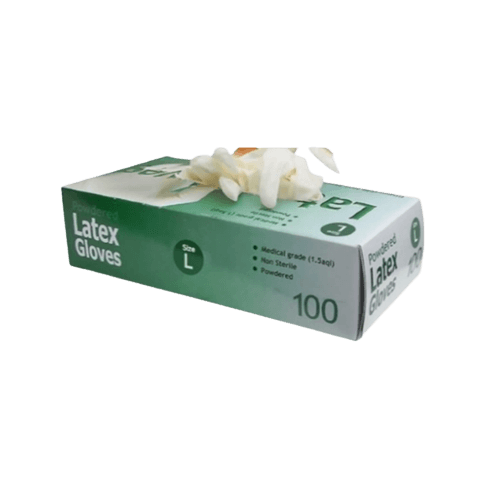
Latex Examination Gloves: a Liquid-Proof Barrier Between Your Hands and Whatever You Are Handling
These latex examination gloves put a liquid-proof barrier between your hands and blood, body fluids, wound dressings, cleaning chemicals and anything else you would rather not touch, so they stop at the glove instead of reaching your skin, and your hands carry nothing on to the next person or the next surface. They are the gloves used across consulting rooms, laboratories, salons and cleaning rounds.
They are made from natural rubber latex, which is still the most comfortable glove material there is: it stretches to the hand, grips when wet, and lets you feel a vein, a lump or a splinter through it in a way thicker gloves prevent. They are ambidextrous, so either glove goes on either hand, and they are single use. Our pharmacist sizes you from a palm measurement and will supply more than one size where a team shares a box.
Getting the Size Right, Which Decides Everything Else
A glove that fits is a glove that gets worn, and a glove that fits is also a glove that lasts a shift without tearing.
Too big and the fingertips bag, you lose the feel the latex was bought for, and the loose material catches and tears. Too small and the glove stretches thin at the knuckles and fingertips, your hand tires and cramps within the hour, and the thin points are where it splits.
Measure across your palm at the widest point, not counting the thumb, and tell our pharmacist the figure in centimetres. Roughly: under 8 cm is small, 8 to 9 cm medium, 9 to 10 cm large. If you are between sizes and the work is fiddly, take the smaller; if it is heavy or wet, take the larger.
Buy more than one size if more than one person uses the box, which in a clinic or a salon is almost always the case. A box of mediums shared across six people means four of them are wearing the wrong glove.
Putting Them On, Taking Them Off, and the Part Everyone Gets Wrong
Clean your hands before you put gloves on and again after you take them off. Gloves work alongside hand washing rather than instead of it, and this is the single commonest mistake made with them. Hands come out of gloves with more on them than people expect.
Put them on dry hands; damp hands drag and tear the latex. Work the fingers in first and ease the cuff up rather than hauling on it.
Taking them off is where contamination happens, so do it in this order. Pinch the outside of one glove at the wrist and peel it off inside out, holding it balled in the gloved hand. Then slide a bare finger under the cuff of the second glove, from the inside, and peel that one off over the first so the two end up bundled with the dirty surfaces inside. Bin them and clean your hands.
One pair, one task. A glove is a single-use item, and washing a disposable glove or wiping it with sanitiser weakens the latex and leaves holes too small to see. Change them between patients, between tasks, and the moment one tears.
Latex Allergy: Please Read This Before Buying a Case
Natural rubber latex contains proteins that some people’s immune systems react to, and this is the one thing worth understanding before a workplace standardises on latex gloves.
About 1 in 100 people in the general population have a true latex allergy, and among healthcare workers the figure is 8 to 12 in 100, because the exposure is daily and lifelong. A true latex allergy is immediate: itching, hives, a running nose and streaming eyes within minutes, and at its most severe it causes anaphylaxis, which is a medical emergency.
Not every reaction to a glove is a latex allergy, and the distinction matters. Red, dry, cracked hands that build up over days are usually irritant dermatitis, from washing, sweating and friction rather than from the latex. A rash appearing a day or two after wearing gloves is often a reaction to the processing chemicals rather than to latex protein, and changing brand sometimes solves it. Our doctor can tell these apart, and the answer is different for each.
If latex is the problem, the answer is nitrile or vinyl. Synthetic gloves sold as latex-free contain none of the proteins that cause the allergy. Tell our pharmacist and we will source them for you.
And a point most people have never heard: latex proteins cross-react with several ordinary foods, among them banana, avocado, kiwi, papaya, chestnut, tomato and raw potato. Somebody who reacts to those fruits is at higher risk of latex allergy and the other way round, so it is worth mentioning to our doctor before you spend a working life in these gloves.
What These Gloves Are For, and What They Are Not For
They are examination gloves, for examinations, dressings, injections, laboratory work, salon work, food handling and cleaning. They are not surgical gloves, which are sterile, sized by the half and made to a tighter standard for use inside a sterile field.
Latex stands up well to water and body fluids and poorly to oils, petroleum products and some solvents, which swell and weaken the rubber. For an oily or chemical job ask our pharmacist, because nitrile is the right glove there.
For wound care, these sit alongside sterile gauze swabs and Betadine antiseptic, and our pharmacist will put a dressing kit together for you. If you are also buying masks, our blue surgical face masks are the clinical grade and the black 3 ply masks are the everyday one.
Is a Latex Examination Glove Right for You?
Latex suits most people and most everyday clinical work. Please speak to our pharmacist or our doctor before ordering if any of these apply:
- You or anybody on your team has ever reacted to latex gloves, a latex catheter or a balloon. Please see our doctor, and buy nitrile in the meantime. Reactions tend to get stronger with repeated exposure rather than milder.
- You react to banana, avocado, kiwi, papaya, chestnut, tomato or raw potato. Tell our doctor before you commit to latex gloves for daily work.
- You are buying for a facility and need the certificates on file. Ask our pharmacist, and we will supply what the supplier holds with your order.
- The work involves oils, petrol, solvents or chemotherapy drugs. Latex is the wrong glove for those. Tell us what the job is and we will source nitrile.
- You need sterile gloves for a procedure. These are examination gloves, which are not sterile. Ring us and tell us what the procedure is.
Our pharmacists will size you, supply more than one size for a team, and our doctor is here if anybody’s hands are reacting to the gloves they wear all day.
Where to Buy Latex Examination Gloves in Kenya
Order online and we deliver countrywide, or collect from our pharmacy at Kahawa Sukari Shopping Center, Nairobi. We send orders to Nairobi and every neighbourhood around it — the CBD, Westlands, Parklands, Gigiri, Muthaiga, Runda, Rosslyn, Kitisuru, Lower Kabete, Lavington, Kileleshwa, Kilimani, Karen, Langata, South B, South C, Eastleigh, Buruburu, Donholm, Embakasi, Ngong Road, Kasarani, Roysambu, Zimmerman, Githurai, Ruaka, Banana Hill, Two Rivers, Village Market and Pride Lands — and across Kiambu, Thika, Juja, Ruiru, Kikuyu, Limuru and Ngong.
Beyond the capital we deliver to Mombasa, Kisumu, Nakuru, Eldoret, Nyeri, Machakos, Athi River, Kitengela, Kajiado, Naivasha, Narok, Kericho, Bomet, Kisii, Migori, Homa Bay, Siaya, Bungoma, Busia, Kakamega, Vihiga, Webuye, Kitale, Nandi Hills, Iten, Kapenguria, Embu, Meru, Chuka, Kerugoya, Murang’a, Othaya, Nyahururu, Nanyuki, Maralal, Isiolo, Marsabit, Moyale, Wajir, Mandera, Garissa, Lodwar, Kitui, Mwingi, Makueni, Emali, Kibwezi, Voi, Taveta, Wundanyi, Mariakani, Diani, Ukunda, Kilifi, Watamu, Malindi, Lamu and Hola. Tell us your palm measurement, or how many people you are covering and in what mix of sizes, and we will send the right boxes.
Across Africa, ask us before you order. We have sent orders to Uganda, Tanzania, Somaliland and as far as Malawi, and we will quote for Rwanda, Burundi, South Sudan, Ethiopia, Zambia, Zimbabwe, Botswana, Mozambique, Nigeria, Ghana, South Africa and the rest of the continent. Tell us the destination and we will confirm any import paperwork before the parcel leaves us.
Living abroad? Order from wherever you are and we deliver here in Kenya. Kenyans in the UK, the United States, Canada, South Africa and the Gulf order from us regularly for a parent or relative at home, and this is one of the things they order most. Tell us the address and we will deliver and set it up.
Why Buy Your Latex Examination Gloves from HealthAlone Kenya?
HealthAlone is a pharmacist-led health ecosystem licensed by the Pharmacy and Poisons Board, and our stock is original, sealed and correctly stored. Kahawa Sukari is a real counter with real pharmacists behind it.
A glove is a product where the fit and the allergy question decide whether it works, and neither gets asked at a stall. Our pharmacists size you, supply more than one size for a team, and our doctor is here if anybody’s hands are reacting.
It is one more step in our vision: building Africa’s most trusted health ecosystem, accessible to everyone, everywhere.
FAQs
What size latex examination gloves do I need?
Measure across your palm at the widest point, not counting the thumb, and tell our pharmacist the figure. Roughly, under 8 cm is small, 8 to 9 cm is medium and 9 to 10 cm is large. Between sizes, take the smaller for fiddly work and the larger for heavy or wet work. If several people share a box, buy more than one size.
How many gloves are in a box?
Please ask our pharmacist for the count and the sizes in stock when you order, and tell us how many people you are covering so we send the right mix.
What is the right way to take gloves off?
Pinch the outside of one glove at the wrist and peel it off inside out, holding it balled in your gloved hand. Then slide a bare finger under the cuff of the second glove from the inside and peel it off over the first, so both end up bundled with the dirty surfaces inside. Bin them and clean your hands. Taking gloves off is where most contamination happens.
Do I still need to wash my hands if I wear gloves?
Yes, before putting them on and again after taking them off. Gloves work alongside hand hygiene rather than instead of it, and this is the commonest mistake made with them. Hands come out of gloves with more on them than people expect.
Can I wash and reuse a glove?
Please do not. These are single use. Washing a disposable glove, or wiping it with sanitiser, weakens the latex and leaves holes too small to see. Change them between patients, between tasks, and the moment one tears.
How common is latex allergy?
About 1 in 100 people in the general population, and 8 to 12 in 100 among healthcare workers, because their exposure is daily and lifelong. A true latex allergy is immediate: itching, hives, a running nose and streaming eyes within minutes, and at its most severe anaphylaxis, which is a medical emergency.
My hands are red and cracked after wearing gloves. Is that a latex allergy?
Often it is not. Red, dry, cracked hands building up over days are usually irritant dermatitis from washing, sweating and friction. A rash appearing a day or two after wearing gloves is frequently a reaction to the processing chemicals rather than to latex protein, and changing brand sometimes solves it. Our doctor can tell these apart, and the answer differs for each.
What should I use instead if I am allergic to latex?
Nitrile or vinyl. Synthetic gloves sold as latex free contain none of the proteins that cause the allergy. Tell our pharmacist and we will source them for you, and please see our doctor, because reactions tend to get stronger with repeated exposure rather than milder.
Is it true that latex allergy is linked to certain fruits?
Yes. Latex proteins cross-react with banana, avocado, kiwi, papaya, chestnut, tomato and raw potato, among others. Someone who reacts to those fruits is at higher risk of latex allergy, and the other way round. It is worth mentioning to our doctor before committing to latex gloves for daily work.
Are these sterile?
These are examination gloves, which are not sterile. Surgical gloves are sterile, sized by the half and made to a tighter standard for use inside a sterile field. Tell our pharmacist what the procedure is and we will tell you which you need.
Can I use them for oils, petrol or solvents?
Latex stands up well to water and body fluids and poorly to oils, petroleum products and some solvents, which swell and weaken the rubber. Nitrile is the right glove for those jobs, and for chemotherapy drugs. Tell our pharmacist what the work involves.
Can I use latex gloves for food handling?
They are used for it widely. Where anybody handling or eating the food may have a latex allergy, vinyl or nitrile is the safer choice, and many kitchens standardise on those for that reason alone. Ask our pharmacist and we will advise for your setting.
Where can I buy latex examination gloves in Kenya?
Order from HealthAlone online and we deliver countrywide, or collect from our pharmacy at Kahawa Sukari Shopping Center, Nairobi. We deliver across Nairobi — the CBD, Westlands, Parklands, Lavington, Kileleshwa, Kilimani, Karen, Langata, South B, South C, Eastleigh, Buruburu, Donholm, Embakasi, Kasarani, Roysambu, Zimmerman, Githurai and Ruaka — and across Kiambu, Thika, Juja, Ruiru, Kikuyu, Limuru and Ngong, as well as Mombasa, Kisumu, Nakuru, Eldoret, Nyeri, Machakos, Kitengela, Naivasha, Narok, Kericho, Kisii, Bungoma, Kakamega, Kitale, Embu, Meru, Chuka, Murang’a, Nyahururu, Nanyuki, Isiolo, Garissa, Lodwar, Kitui, Voi, Kilifi, Malindi and Diani. Tell us your palm measurement and we will send the right size.
