

CADY Malaria Test Kit: a Blood Test for Malaria Antigens, Read in Under 30 Minutes
This CADY malaria test kit helps you find out whether a fever is malaria, from a few drops of blood, with a result in under 30 minutes. It detects the antigens that malaria parasites release into the blood, and it reads as lines on a cassette.
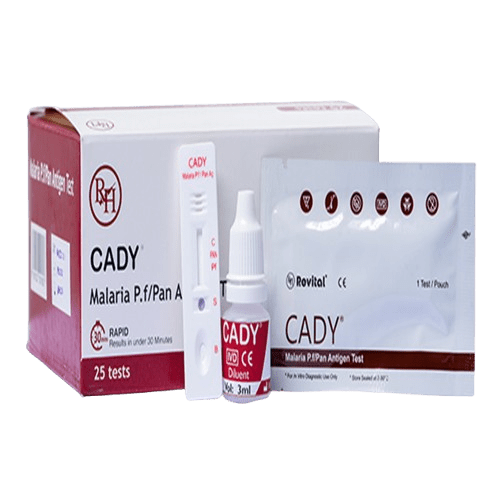
The full name on the box is CADY Malaria P.f/Pan Antigen Test, made by Rovital, supplied as single sealed pouches of one cassette each with a 3 ml bottle of buffer. Each pouch is marked for in vitro diagnostic use and stored sealed between 2 and 30 degrees Celsius. Everything needed for the reaction is in the pouch, though you supply the lancet, the swab and a clean surface.
What the Lines on a CADY Malaria Test Kit Mean
The cassette has three positions, marked C, Pf and Pan, and reading them together is what makes this test useful rather than just positive or negative.
C is the control. A line there confirms the test ran. With no line at C, the result is void whatever else appears, and it needs a fresh cassette.
Pf is for Plasmodium falciparum, the species responsible for almost all malaria in Kenya and for nearly all of the severe and fatal disease. A line at Pf is the one that means act today.
Pan covers the genus as a group — P. vivax, P. ovale and P. malariae. A Pan line with no Pf line points to a non-falciparum infection. Worth knowing honestly: this test separates falciparum from the rest. It stops short of telling you which of the other three you have, and that distinction matters for treatment, so a Pan-positive result is one to bring to our doctor rather than to interpret at home.
Running the Test Properly
Lay everything out first: the pouch, the buffer, a lancet, an alcohol swab and a clean flat surface. Open the pouch only when you are ready, since the cassette begins reacting to moisture in the air, and use it within the time the leaflet allows.
Clean the side of a fingertip and let it dry. Prick the side rather than the pad, let a drop form rather than squeezing hard, and transfer the volume the leaflet specifies into the sample well marked S. Then add the stated number of buffer drops into the well marked B, holding the bottle upright so the drops are a consistent size. Set a timer and read inside the window on the leaflet, which for this kit is under 30 minutes.
Read it once, at the stated time, and treat anything that appears later as meaningless. Dispose of the lancet where nobody can be pricked by it, and bring it to us if you would rather it went into our sharps bin.
A Positive Result: What Happens Next
Ring us and ask for our doctor the same day, and sooner than that for a child, a pregnant woman or anyone who looks unwell. Falciparum malaria can move from a fever to something serious inside a day, so this is a same-day matter rather than a see-how-it-goes one.
Kenya’s national guidelines call for every suspected case to be confirmed by a test before treatment, which is exactly what this kit is for. The treatment that follows is artemether-lumefantrine, which we stock as Lonart tablets — a prescription medicine, taken as a timed 3-day course where the doses matter as much as the tablets. Our doctor can assess you, prescribe it and set the schedule, and our pharmacist will go through the timing with you.
Finishing the whole course matters even after the fever breaks, which it usually does within a day or two. Stopping early is how malaria comes back and how resistance builds. Keep a digital thermometer to hand and write the readings down, because a temperature that climbs again after day 3 of treatment is something our doctor wants to hear about.
When a Result Can Mislead You
Rapid tests are good and they have known limits, and knowing them is the difference between using one well and trusting it blindly.
A positive soon after treatment may be left-over antigen. The falciparum antigen these tests detect stays in the blood for weeks after the parasites have gone — often around a month, and longer where the infection was heavy. If you were treated for malaria in the last 4 to 6 weeks, a positive line may be an echo of that rather than a new infection, and our doctor can tell the difference.
A negative result leaves malaria possible. The test needs a certain number of parasites in the blood to see them, and early in an illness there may be too few. Some parasites in this region have lost the gene for the antigen altogether and read negative however ill the person is. And at the opposite extreme, a very heavy infection can overwhelm the chemistry and read falsely negative too, which is the worst possible moment for it.
So a negative result with a continuing fever means test again in 12 to 24 hours and see our doctor, who can arrange a blood slide read under a microscope. In pregnancy the test is markedly less reliable, so a pregnant woman with a fever belongs in front of our doctor whatever the cassette says.
Signs That Mean Go Now Rather Than Test
Take the person straight to hospital, without waiting for a test, for any of these: confusion, drowsiness or difficulty rousing them; a fit or convulsion; fast, laboured or deep breathing; being too weak to sit, stand or walk unaided; repeated vomiting or inability to keep fluids down; very dark or cola-coloured urine, or passing little urine; yellowing of the eyes; unusual bleeding or bruising; or a fever in a baby under 3 months.
Treatment for severe malaria should begin without waiting for a result, and a test taken at home costs time that matters more than the information. Children under 5 and pregnant women reach that point faster than anybody else.
Is a Malaria Test Kit Right for You?
A rapid test is a sensible thing to keep in a household in an area where malaria circulates. Please speak to our pharmacist or our doctor before relying on a result if any of these apply:
- Any of the danger signs above are present. Go to hospital rather than testing.
- You were treated for malaria in the last 6 weeks. A positive line may be residual antigen rather than a new infection, and our doctor can distinguish them.
- The test is negative and the fever continues. Repeat in 12 to 24 hours and see our doctor, who can arrange a blood slide.
- The person is pregnant, under 5, elderly, or living with HIV or another condition that lowers immunity. These groups become seriously unwell fastest and the test performs least well in pregnancy.
- The Pan line is positive and the Pf line is blank. That points to a non-falciparum species, which the kit stops short of naming, and the treatment differs.
- You are buying it to treat yourself without a consultation. Antimalarials require a prescription, the dosing is weight-based and timed, and our doctor can issue one the same day.
Our pharmacists will show you how to run the test and read the three lines, and our doctor is here for the result either way.
Where to Buy a Malaria Test Kit in Kenya
Order online and we deliver countrywide, or collect from our pharmacy at Kahawa Sukari Shopping Center, Nairobi. We send orders to Nairobi and every neighbourhood around it — the CBD, Westlands, Parklands, Gigiri, Muthaiga, Runda, Rosslyn, Kitisuru, Lower Kabete, Lavington, Kileleshwa, Kilimani, Karen, Langata, South B, South C, Eastleigh, Buruburu, Donholm, Embakasi, Ngong Road, Kasarani, Roysambu, Zimmerman, Githurai, Ruaka, Banana Hill, Two Rivers, Village Market and Pride Lands — and across Kiambu, Thika, Juja, Ruiru, Kikuyu, Limuru and Ngong.
Beyond the capital we deliver to Mombasa, Kisumu, Nakuru, Eldoret, Nyeri, Machakos, Athi River, Kitengela, Kajiado, Naivasha, Narok, Kericho, Bomet, Kisii, Migori, Homa Bay, Siaya, Bungoma, Busia, Kakamega, Vihiga, Webuye, Kitale, Nandi Hills, Iten, Kapenguria, Embu, Meru, Chuka, Kerugoya, Murang’a, Othaya, Nyahururu, Nanyuki, Maralal, Isiolo, Marsabit, Moyale, Wajir, Mandera, Garissa, Lodwar, Kitui, Mwingi, Makueni, Emali, Kibwezi, Voi, Taveta, Wundanyi, Mariakani, Diani, Ukunda, Kilifi, Watamu, Malindi, Lamu and Hola. Every order travels in plain outer packaging with nothing on the outside to say what is inside, and the delivery note carries our name and no product description. If collection suits you better, tell us and we will set it aside under a first name only.
Across Africa, ask us before you order. We have sent orders to Uganda, Tanzania, Somaliland and as far as Malawi, and we will quote for Rwanda, Burundi, South Sudan, Ethiopia, Zambia, Zimbabwe, Botswana, Mozambique, Nigeria, Ghana, South Africa and the rest of the continent. Tell us the destination and we will confirm any import paperwork before the parcel leaves us.
Living abroad? Order from wherever you are and we deliver here in Kenya. Kenyans in the UK, the United States, Canada, South Africa and the Gulf order from us regularly for family at home. A test kept for an emergency is the one most likely to have been stored badly, so check the expiry and keep it sealed between 2 and 30 degrees Celsius rather than in a car or on a windowsill.
Why Buy Your a Malaria Test Kit from HealthAlone Kenya?
HealthAlone is a pharmacist-led health ecosystem licensed by the Pharmacy and Poisons Board, and our stock is original, sealed, in date and correctly stored. Kahawa Sukari is a real counter with real pharmacists behind it.
Our pharmacists will tell you when to test and how to read what you see, and will set up the folic acid that every woman who could become pregnant should be taking. Our doctor is here for a positive result, for a negative result where the period still has not come, and for the point where trying has gone on long enough to want answers rather than another test.
It is one more step in our vision: building Africa’s most trusted health ecosystem, accessible to everyone, everywhere.
FAQs
How long does a CADY malaria test kit take?
Under 30 minutes, as printed on the box, and the leaflet in your pouch gives the exact reading window. Set a timer, read once at the stated time, and treat anything that appears afterwards as meaningless.
What do the Pf and Pan lines mean?
C is the control and confirms the test ran; with no line there the result is void. Pf is Plasmodium falciparum, the species behind almost all malaria in Kenya and nearly all severe disease. Pan covers the genus as a group, meaning P. vivax, P. ovale and P. malariae. A Pan line with no Pf line points to a non-falciparum infection, and the kit stops short of naming which, so bring that result to our doctor.
My test is positive. What should I do?
Ring us and ask for our doctor the same day, and sooner for a child, a pregnant woman or anyone who looks unwell. Falciparum malaria can move from a fever to something serious inside a day. Kenya’s guidelines call for a test before treatment, which is what this kit provides, and the treatment is artemether-lumefantrine on a timed 3-day course, which our doctor prescribes.
The test is negative but the fever continues. What now?
Test again in 12 to 24 hours and see our doctor. Early in an illness there may be too few parasites for the test to see. A blood slide read under a microscope answers what a rapid test leaves open, and our doctor can arrange one.
I was treated for malaria last month and the test is still positive.
That is common and usually not a new infection. The falciparum antigen this test detects stays in the blood for weeks after the parasites have gone, often around a month, and longer where the infection was heavy. Our doctor can tell residual antigen from a fresh infection, which matters because taking another course for no reason helps nobody.
Can a rapid test miss malaria?
Yes, in three ways worth knowing. Too few parasites early in the illness. Some parasites in this region have lost the gene for the antigen altogether and read negative however ill the person is. And a very heavy infection can overwhelm the chemistry and read falsely negative, which is the worst moment for it. A negative result in somebody who is unwell is a reason to see our doctor rather than to relax.
When should we go straight to hospital instead of testing?
For confusion, drowsiness or difficulty rousing; a fit or convulsion; fast, laboured or deep breathing; being too weak to sit, stand or walk unaided; repeated vomiting; very dark or cola-coloured urine, or passing little urine; yellowing of the eyes; unusual bleeding; or a fever in a baby under 3 months. Treatment for severe malaria should begin without waiting for a result.
Is it safe to use in pregnancy?
The test itself is a blood test and carries no risk. What changes is how well it performs: in pregnancy its sensitivity is markedly lower, particularly late on, so a pregnant woman with a fever belongs in front of our doctor whatever the cassette shows. Pregnant women also become seriously unwell faster than most people.
What else do I need to run the test?
The pouch holds the cassette and the buffer comes in a 3 ml bottle. You supply a sterile lancet, an alcohol swab, a clean flat surface and somewhere safe to dispose of the lancet. Our pharmacist will put the extras together with the kit, and you can bring the used lancet to us for our sharps bin.
How should I store it?
Sealed, between 2 and 30 degrees Celsius, which rules out a car and a windowsill in most of Kenya. Check the expiry on the pouch before use. Heat and damp are the usual reasons a cassette fails or reads faintly, and a kit kept for an emergency is exactly the one most likely to have been stored badly.
Can I buy the malaria treatment at the same time?
Artemether-lumefantrine is a prescription medicine, so our doctor assesses you first and can issue the prescription the same day. The dosing is weight-based and timed over 3 days, and finishing the course after the fever breaks is what stops it returning. Our pharmacist will go through the schedule with you.
Can children use it?
The test works at any age and children under 5 are the group that becomes seriously unwell fastest, so a positive result in a child is urgent rather than routine. Please ring our doctor the same day. For a baby under 3 months, any fever is a same-day matter whatever the test shows.
Is this the same test a clinic uses?
It is the same class of test, and it is supplied as a professional in vitro diagnostic in a 25-test clinic box. What a clinic adds is a trained pair of hands, a microscope where the rapid test is unclear, and somebody to act on the answer. That is what our pharmacist and our doctor are here for.
Where can I buy a CADY malaria test kit in Kenya, and what does it cost?
From HealthAlone, online for delivery countrywide or over the counter at Kahawa Sukari Shopping Center, Nairobi. The current price is shown above. We deliver across Nairobi — the CBD, Westlands, Parklands, Gigiri, Muthaiga, Runda, Kitisuru, Lavington, Kilimani, Karen, Langata, South B, South C, Eastleigh, Kasarani, Roysambu, Githurai, Ruaka and Banana Hill — and to Kiambu, Thika, Juja, Ruiru, Kikuyu, Limuru, Ngong, Mombasa, Kisumu, Nakuru, Eldoret, Nyeri, Machakos, Kitengela, Naivasha, Narok, Kericho, Kisii, Migori, Homa Bay, Bungoma, Busia, Kakamega, Kitale, Embu, Meru, Nanyuki, Nyahururu, Isiolo, Marsabit, Wajir, Mandera, Garissa, Lodwar, Kitui, Makueni, Voi, Taveta, Mariakani, Diani, Ukunda, Kilifi, Watamu, Malindi and Lamu. Outside Kenya we have delivered to Uganda, Tanzania, Somaliland and Malawi, and we quote for Rwanda, Burundi, South Sudan, Ethiopia, Zambia, Zimbabwe, Nigeria, Ghana, South Africa and the rest of Africa on request. Our pharmacist will put the lancet and swab together with the kit and show you how to read the three lines, and our doctor can prescribe the treatment the same day a result comes back positive.
