

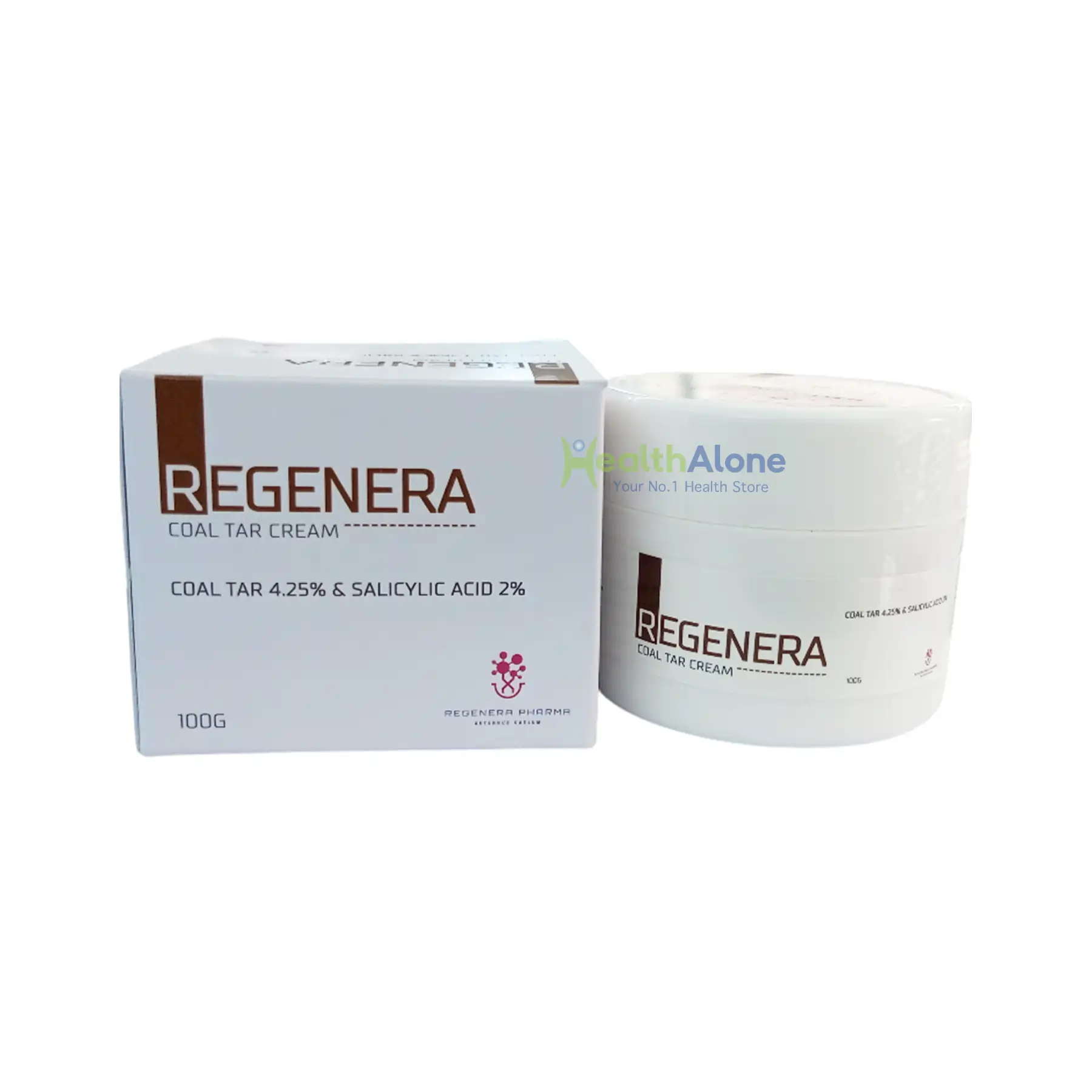
Buy Coal Tar Cream Online in Kenya – Regenera Coal Tar & Salicylic Acid Cream
Coal tar cream is one of the oldest and most reliable treatments for scaly, thickened skin conditions — psoriasis, seborrheic dermatitis, chronic eczema and stubborn scalp flaking. This one combines coal tar 4.25%, which slows the runaway skin-cell production behind the scaling, with salicylic acid 2%, which lifts the scale already there so the tar can reach the skin underneath.
It is not glamorous and it smells of what it is. At HealthAlone, a licensed, pharmacist-led Kenyan health store, you get the original sealed product and an honest account of how to use it — including the practical realities nobody mentions until after you have bought it.
What Coal Tar Cream Actually Does
In psoriasis and similar conditions, skin cells are produced far faster than they can be shed, piling up as the thick, scaly plaques that itch, crack and flake.
Coal tar slows that overproduction. It also reduces itching and inflammation, which is why relief often arrives before the plaque visibly changes.
Salicylic acid does the complementary job: it softens and lifts built-up scale. That matters more than it sounds, because a thick scale layer blocks anything applied on top from reaching the skin beneath. Removing the scale is what lets the tar work.
What It Is Used For
Psoriasis, on the body and the scalp — the condition coal tar is best known for. Seborrheic dermatitis — the greasy scaling on the scalp, hairline, eyebrows and sides of the nose. Chronic, thickened eczema — skin gone leathery and scaly from years of scratching, where a plain moisturiser is no longer enough. And stubborn dandruff and scalp flaking that ordinary shampoos have not settled.
It manages these conditions rather than curing them. Psoriasis in particular comes and goes; the aim is to keep it quiet, not to finish it.
How Psoriasis Looks on Melanin-Rich Skin
This is worth reading even if you are not sure what you have, because psoriasis is frequently missed on darker skin.
Textbooks describe red plaques with silvery scale. On melanin-rich skin the plaques are usually violet, grey-brown, or simply darker than the surrounding skin, with scale that looks thicker and more strikingly white against them. Because the redness doctors are trained to look for is absent, psoriasis here is often mistaken for ringworm or eczema, and tends to be more extensive by the time it is identified.
A second thing surprises people. After a plaque settles it commonly leaves a dark patch that lasts months, sometimes a pale one instead. That mark is not active psoriasis. It is pigment left behind, and it fades slowly on its own.
One practical warning follows from this: if psoriasis is mistaken for a fungal infection and treated with a combination steroid cream, it looks better for a week or two and then rebounds worse. If a cream keeps helping and then failing, get the diagnosis confirmed.
Is Coal Tar Safe?
People ask, and the honest answer takes a moment.
The concern comes from industrial exposure — workers handling coal tar in high concentrations over years, often breathing it, over the whole body. That is a different situation from a measured pharmaceutical concentration on affected areas. Therapeutic coal tar has been in medical use for more than a hundred years, and the largest study following dermatology patients treated with it found no increased cancer risk. Some regulators do restrict higher-strength preparations, which is why products like this are formulated at set concentrations.
The sensible position: use it as directed, for the areas that need it, and do not continue indefinitely without a review. If you are using it for months on end, that is a conversation with a doctor rather than a repeat purchase.
Key Benefits of Coal Tar & Salicylic Acid Cream
- Coal tar 4.25% slows the excess skin-cell production behind scaling
- Salicylic acid 2% lifts built-up scale so the tar can reach the skin
- Helps relieve itching, often before the plaque visibly changes
- Used for psoriasis, seborrheic dermatitis and chronic thickened eczema
- Works on the scalp as well as the body
- Softens rough, leathery patches that moisturiser alone will not shift
- A long-established treatment with over a century of clinical use
How to Use Coal Tar Cream
- Apply a thin layer to the affected areas once or twice daily, depending on how severe the scaling is.
- Reduce the frequency as the skin improves rather than stopping abruptly.
- On the scalp, work it into the affected patches, leave it as directed, then wash out with a mild shampoo.
- Wash your hands afterwards unless your hands are being treated.
- Give it time. Itching often eases within days, but scaling takes two to four weeks to change properly.
Three practical things nobody warns you about.
It stains. Clothing, bedding, towels, and sometimes bath surfaces. Apply at night, use old bedding and dark towels you do not mind marking, and wash treated fabrics separately.
It smells. Distinctly. Most people apply it in the evening for this reason, which conveniently is also when it has the most undisturbed hours to work.
It makes your skin more sensitive to the sun — and Kenya sits on the equator with strong ultraviolet all year. Keep treated skin covered or out of direct sun, particularly in the hours after applying. This matters more here than in the countries where most coal tar advice is written.
Who Is It For?
It suits people managing psoriasis on the body or scalp, persistent seborrheic dermatitis, eczema gone thickened and scaly from years of scratching, and scalp flaking that has not responded to ordinary or medicated shampoos.
It is not the right product for acute, weeping or infected skin, for open cracks, or for a rash nobody has diagnosed. If you are not sure what you have, message our pharmacist and describe it before you buy — coal tar is excellent for the right condition and unhelpful for the wrong one.
Safety note: for external use only; keep away from the eyes, mouth and genitals, and rinse with clean water if it gets in the eyes. Do not apply to broken, weeping, blistered, infected or acutely inflamed skin, or to open cracks. Avoid the face unless a doctor has directed it. Patch test before first use; coal tar can cause irritation or a folliculitis-type rash in some people. It increases sensitivity to sunlight — keep treated skin covered and avoid strong sun and any UV treatment while using it. Salicylic acid also raises sun sensitivity and should not go over large areas of a child’s skin. Do not use on children unless a doctor has directed it, and tell your pharmacist if you are pregnant or breastfeeding. Do not combine it with other tar or salicylic acid products without advice. Stop and seek advice if the skin burns, blisters, spreads or does not improve within the expected time. Keep out of reach of children. This product manages scaling and itching; it does not cure psoriasis, seborrheic dermatitis or eczema, which are long-term conditions needing proper medical management. See a doctor for skin that is painful, cracked open, weeping, infected, rapidly spreading, or covering a large area of the body.
Why Buy from HealthAlone Kenya?
Psoriasis is commonly misdiagnosed in Kenya, and people often arrive at coal tar after months of the wrong creams. HealthAlone is a pharmacist-led African health ecosystem, licensed by the Pharmacy and Poisons Board. Everything we sell is original, sealed and correctly stored, and you will see the current price right on this page, always accurate rather than a figure gone stale elsewhere. Describe what you are dealing with to our pharmacist before you order — we will say honestly whether coal tar is the right answer, whether something gentler fits better, or whether it needs a dermatologist to confirm what it actually is.
We deliver across Nairobi and all major Kenyan towns — Mombasa, Kisumu, Nakuru, Eldoret, Thika and beyond — and we serve customers across East Africa, including Tanzania and Uganda. You can also collect your order at our shop at Kahawa Sukari Shopping Center, Nairobi. Living abroad? Order online from the US or UK and we deliver to your family in Kenya. It is one more step in our vision: building Africa’s most trusted health ecosystem, accessible to everyone, everywhere.
Frequently Asked Questions
What is coal tar cream used for?
It is used for scaly, thickened skin conditions — psoriasis on the body and scalp, seborrheic dermatitis, chronic thickened eczema, and stubborn dandruff or scalp flaking. The coal tar slows the excess skin-cell production that causes the scaling and eases itching, while the salicylic acid lifts the built-up scale so the tar can reach the skin underneath.
Does coal tar cream cure psoriasis?
No. Psoriasis is a long-term condition that comes and goes, and no cream cures it. What coal tar does is manage it — reducing scaling, easing itching and helping keep plaques quiet. Many people use it during flares and less often in between. If your psoriasis is widespread, painful, or affecting your joints, see a doctor: there are treatments beyond creams.
Is coal tar safe? Does it cause cancer?
The concern comes from industrial exposure — workers handling coal tar in high concentrations over years, often inhaling it and over the whole body. Therapeutic use is a different situation: coal tar has been used in medicine for over a century, and the largest study following dermatology patients treated with it found no increased cancer risk. Some regulators restrict higher-strength preparations, which is why products are formulated at set concentrations. Use it as directed, and if you find yourself using it for months on end, discuss that with a doctor.
Does it stain clothes and bedding?
Yes, and it is worth planning for. Coal tar stains clothing, bedding, towels and sometimes bath surfaces. Most people apply it at night using old bedding and dark towels they do not mind marking, and wash treated fabrics separately. This is the main practical reason people abandon coal tar, so knowing it in advance helps.
Does it smell?
Yes, distinctly — it smells of tar, because it is. There is no getting around it. Applying it in the evening is the usual solution, which also gives it undisturbed hours to work.
How long does it take to work?
Itching often eases within a few days. Scaling takes longer — expect two to four weeks of consistent use before plaques change noticeably, and remember that a dark mark left behind after a plaque settles is pigment, not active disease, and fades on its own over months.
Can I use it on my scalp?
Yes. It is used for scalp psoriasis, seborrheic dermatitis and stubborn flaking. Work it into the affected patches, leave it as directed, then wash out with a mild shampoo. Keep it away from the eyes and rinse with clean water if any gets in.
Do I need to avoid the sun while using it?
Yes, and this matters more in Kenya than in most places. Both coal tar and salicylic acid make skin more sensitive to ultraviolet light, and equatorial sun is strong all year. Keep treated skin covered or out of direct sun, particularly in the hours after applying, and avoid any UV treatment while using it.
Where can I buy coal tar cream in Kenya?
You can buy Regenera Coal Tar & Salicylic Acid Cream online at HealthAlone, a licensed Kenyan health store. We deliver across Nairobi, Mombasa, Kisumu, Nakuru, Eldoret, Thika and the rest of Kenya, and we serve customers in East Africa, including Tanzania and Uganda. You can also buy it in person at our shop at Kahawa Sukari Shopping Center, Nairobi.