

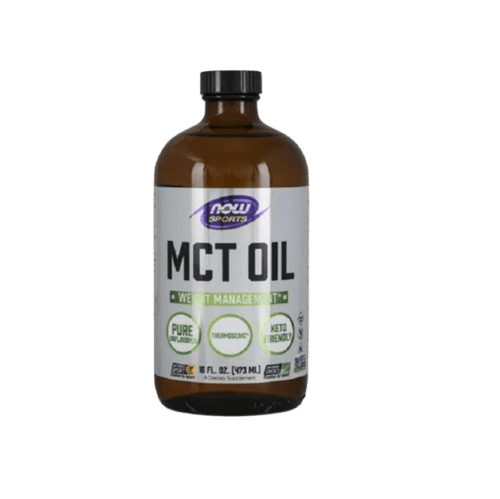
Buy MCT Oil Online in Kenya – 473ml, 50% C8 Caprylic Acid
MCT oil 473ml is a 50% C8 caprylic and 30% C10 capric acid blend from coconut and palm kernel oil, unflavoured, formulated to help supply fast-burning fat energy on a ketogenic or low-carbohydrate diet.
One tablespoon is 130 calories and 14 grams of fat, and that number decides whether this product helps you or works against you. Added to a diet that stays otherwise the same, it is 130 calories you were not eating before. Used in place of the butter, ghee or cooking oil you would have had anyway, it is a swap rather than an addition — and only the swap has ever been the honest case for it.
What MCT Oil Is
MCT stands for medium-chain triglyceride, which describes the length of the fat molecule rather than a brand or a process. Ordinary cooking fats are long-chain. Medium-chain fats are shorter, and that one structural difference is the whole of what makes them behave differently in the body.
Long-chain fats are packaged up in the gut, sent into the lymph system and delivered slowly to the body. Medium-chain fats skip most of that. They are absorbed straight into the blood that goes to the liver, and the liver either burns them immediately or turns them into ketones, which are a fuel the brain and muscle can use when carbohydrate is scarce.
That is a real and well-established difference, and it is the reason this product exists. It is also the point at which most pages stop describing biology and start promising results, so this one will say plainly what the difference does and does not buy you.
The Arithmetic Every MCT Oil Page Avoids
This product is widely sold on weight loss. Its own nutrition panel is the strongest argument against buying it for that reason alone, and we would rather you read the panel here than discover it later.
One tablespoon, 15ml, is 130 calories. Fourteen of the fifteen grams are fat. There is no version of this in which a spoonful of oil in your coffee is a calorie-free addition. The research that shows any weight effect at all is substitution research: people who replaced part of the fat they were already eating with medium-chain fat, not people who added a spoonful to an unchanged diet. The effect in those studies is modest and it depends entirely on the substitution.
So the rule is short. If it replaces fat you were eating anyway, it may help a little. If it is extra, it is extra. Butter in your coffee instead of the tablespoon, not as well as it. Oil in the dressing instead of part of the olive oil, not in addition.
If weight is the whole of your reason for buying, come and talk to our pharmacist first. There are cheaper and more effective places to start, and we would rather lose the sale than sell you a bottle that quietly adds four thousand calories a month to a diet you are trying to reduce.
Where MCT Oil Earns Its Place
On a ketogenic or very low-carbohydrate diet, it is the most useful thing on this page. Ketones are the point of that diet, and medium-chain fats raise them faster and more reliably than any other food fat. It is also a convenient way to hit a fat target when you have run out of appetite for meat and cheese, and the unflavoured oil disappears into coffee and smoothies in a way that solid fats do not.
As quick fuel before or during long exercise, where the appeal is fat that reaches the bloodstream in minutes rather than hours. Useful, though the amount most people tolerate before exercise is small.
As an easier fat to absorb when the ordinary route is not working well, which is a clinical use rather than a shopping decision and is covered below.
What it is not is a thermogenic in the sense the word is usually used. There is a small measurable increase in energy expenditure after a dose. It is real, it has been measured, and it is far smaller than the calories the dose itself contains. It does not add up to a fat burner and we will not describe it as one.
How to Take MCT Oil
- Start at half a tablespoon, not a full one. The stomach adapts, but it adapts over a week or two and not in an afternoon
- Take it with food for the first fortnight. On an empty stomach is where the cramping and the urgent trip to the bathroom come from, and it is the single most common reason a bottle ends up unused in a cupboard
- Build to one tablespoon daily over one to two weeks. Some people go higher; most have no reason to, given what a tablespoon already costs in calories
- Stir it in, do not fry with it. The smoke point is low. Coffee, smoothies, shakes, dressings and sauces off the heat are all fine; a hot pan is not
- Store it cool, dark and tightly sealed. It does not need the fridge and it stays pourable there if you prefer it cold, which is one practical way it differs from coconut oil
What the bottle holds, in plain terms: 473ml is about thirty-one tablespoons, so roughly a month at one a day, or two months at half. Work out which of those you are buying before you compare it with anything else on a shelf, because bottle sizes in this category vary far more than the labels make obvious.
The Saturated Fat Number, Explained Properly
The panel says fourteen grams of saturated fat, which is seventy per cent of a day’s reference intake in one tablespoon. That is a large number and you deserve the context rather than a reassuring sentence.
Medium-chain saturated fats are handled differently from the long-chain saturated fat in butter or red meat, and the trial evidence on blood cholesterol has generally been neutral to mildly favourable rather than harmful. That is the honest version of the reassurance.
Here is the limit of it. Most of that evidence used C8 and C10 specifically, over weeks rather than years, in people who were not otherwise at high risk. If your doctor has told you to reduce saturated fat because of your heart or your cholesterol, seventy per cent of a daily reference intake in one spoonful is not a number to wave away on the strength of that. Take the panel to them and ask. It is a two-minute conversation and it is the right one.
Who Should Ask First
If you have diabetes, particularly type 1, or if you take one of the newer diabetes medicines whose names end in -gliflozin, speak to us or to your doctor before starting. Medium-chain fats raise blood ketones on purpose, and a raised ketone reading is harder to interpret and less safe to ignore in those situations.
If you have liver disease, this is not for you without medical advice. Medium-chain fats are delivered straight to the liver, which is the mechanism that makes them useful and the reason a damaged liver is a genuine caution.
If you have a fat malabsorption condition, the answer is a conversation rather than a refusal. Medium-chain fats are absorbed without the bile salts and pancreatic enzymes that ordinary fats need, which is precisely why they are used in some of those conditions — under supervision, at a dose a clinician sets. Do not start one on your own; do ask, because the answer may well be yes.
If you have a gallbladder problem, irritable bowel syndrome or any condition where fat sets off symptoms, start at a quarter of a tablespoon or ask first. It is for adults. Ask a doctor before taking it in pregnancy or while breastfeeding, and keep it out of reach of children.
Why Buy Your MCT Oil from HealthAlone Kenya?
HealthAlone is a pharmacist-led health ecosystem licensed by the Pharmacy and Poisons Board, and our stock is original, sealed and correctly stored. On a product like this the value of a pharmacy is somebody who will tell you what the panel means, which reasons for buying it are sound and which are not, and when the cheaper thing on the next shelf is the better answer. Ask our pharmacist, and ask before you buy.
We deliver across Kenya — Nairobi first, then Mombasa, Kisumu, Nakuru, Eldoret, Thika and beyond — and across East Africa to Tanzania and Uganda, with the wider African market where we are heading. Collect in person at Kahawa Sukari Shopping Center, Nairobi. Living abroad? Order online from the US or UK and we deliver to your family in Kenya.
It is one more step in our vision: building Africa’s most trusted health ecosystem, accessible to everyone, everywhere.
Frequently Asked Questions
Does it help with weight loss?
Only as a substitution. The studies that show an effect had people replace fat they were already eating with medium-chain fat; they did not have people add a spoonful to an unchanged diet. A tablespoon is 130 calories, so if it is extra, it is extra. Swap it for the butter or the cooking oil, not add it to them, and the modest effect the research describes becomes available to you.
How many calories are in a tablespoon?
One hundred and thirty, from fourteen grams of fat. It is worth knowing before you put two spoonfuls in your morning coffee, because that is a substantial part of a breakfast and it is easy not to count it as food at all.
Why does the label say seventy per cent saturated fat?
Because medium-chain fats are saturated fats, and one tablespoon carries fourteen grams of them. They are handled differently from the saturated fat in butter and the cholesterol evidence has been neutral to mildly favourable rather than harmful. That said, if you have been told to cut saturated fat for your heart, take the panel to your doctor rather than take our word for it.
What is the difference between this and coconut oil?
Coconut oil is roughly half lauric acid, which behaves in the body more like a long-chain fat. This product is a concentrate of the shorter fractions, half caprylic acid and just under a third capric acid, with the balance made up of other medium-chain fats. That concentration is what makes it raise ketones faster, and it is the whole reason to pay more for it than for a jar of coconut oil.
Can I use it on my hair?
Plain coconut oil is the better choice, and it is cheaper. The fraction with the evidence for getting into the hair shaft and reducing protein loss during washing is lauric acid, and lauric acid is largely what has been removed to make this product. Buy the coconut oil for your hair and keep this for the kitchen.
How do I start without upsetting my stomach?
Half a tablespoon, with food, for a week or two, then build up. Bloating, cramping and loose stools are the usual complaints and they come almost entirely from starting too high or taking it on an empty stomach. If symptoms arrive, drop back to the dose that was comfortable and hold there for longer.
Can I cook with it?
Not in a hot pan. The smoke point is low, so frying will degrade it and make the kitchen unpleasant. Stir it into coffee, smoothies, shakes, dressings or a sauce once it is off the heat, and it does everything you bought it for.
Is it safe if I have diabetes?
Ask first. Medium-chain fats raise blood ketones deliberately, which matters most in type 1 diabetes and for anyone taking one of the diabetes medicines whose names end in -gliflozin, where a raised ketone level is both harder to read and less safe to ignore. In well-controlled type 2 diabetes without those medicines it is usually straightforward, but it is still worth a conversation.
How long will the bottle last?
473ml is about thirty-one tablespoons, so roughly a month at the full daily serving and about two at half. Check that against any other bottle you are comparing it with, because sizes in this category differ more than the front label suggests.
Where can I buy MCT oil in Kenya?
Order online from HealthAlone for delivery in Nairobi, Mombasa, Kisumu, Nakuru, Eldoret, Thika and beyond, and across East Africa to Tanzania and Uganda. You can also collect in person at Kahawa Sukari Shopping Center, Nairobi, where a pharmacist will read the panel with you and tell you honestly whether it suits what you are trying to do.