

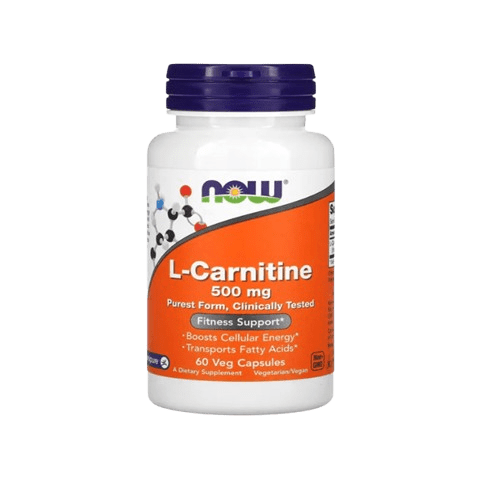
Buy L-Carnitine Online in Kenya – 500mg Carnipure Tartrate, 60 Capsules
L-Carnitine 500mg is Carnipure L-carnitine tartrate in vegetarian capsules, formulated to help support exercise recovery and to top up intake if you eat little or no red meat.
This is sold almost everywhere as a fat burner, and that is the weakest thing it does. The biochemistry behind the claim is real, which is exactly why the claim is so persuasive and so misleading. What the evidence actually supports is recovery after hard training, and topping up if your diet is short of it — two smaller, truer reasons to buy it, and the ones this page is built around.
What L-Carnitine Actually Does
Carnitine is a shuttle. Fatty acids cannot cross into the mitochondria — the part of the cell where fuel is burned — without being carried, and carnitine is what carries them.
That is where “converts fat into energy” comes from, and it is a fair description of the biology. It is also where the reasoning usually stops, and it should not. The question is not what carnitine does; it is whether adding more of it makes the process go faster.
For most people it does not, because the shuttle is not the bottleneck. If you eat meat, your muscles already hold close to as much carnitine as they can. Adding more to a full tank does not move the needle, and oral carnitine is poorly absorbed in any case — most of a dose does not reach muscle at all. That is the part every fat-burner label leaves out.
The Honest Answer on Fat Loss
We would rather lose the sale than have you buy this for the wrong reason and conclude that supplements do not work.
Taken on its own, it will not make you lose fat. The trials that show any weight effect at all show a small one, mostly in people who were overweight to begin with, over months, alongside diet and exercise doing the actual work. It is not a fat burner in the sense the category uses the word, and nothing you can buy in a capsule is.
If fat loss is why you came, the honest order is: food, then sleep, then movement, then perhaps something from a shelf. Come and talk to our pharmacist about the first three. It is a duller conversation than a capsule and it is the one that works.
Where It Does Have Evidence
Two places, and both are more specific than the label suggests.
Recovery after hard training. L-carnitine tartrate — which is precisely the form in this bottle — has reasonable evidence for reducing muscle soreness and markers of muscle damage after demanding sessions. It is the best-supported thing on this page and the page currently buries it fourth in a list. If you train hard enough to be sore two days later, this is the reason to try it.
If you eat little or no red meat. Carnitine comes almost entirely from meat, so vegetarians and vegans genuinely run lower on it. Topping up a diet that is actually short of something is a different proposition from adding more to a diet that is not, and it is the one population where supplementing has a straightforward rationale. This product is vegetarian-friendly, which makes it a sensible fit.
There is also a clinical use in diagnosed carnitine deficiency, which is a real condition and a matter for a doctor rather than a shopping decision.
How to Take It
- One capsule, one to three times a day. Most people do well on one or two; three is for heavy training loads rather than a default
- On an empty stomach is what the label advises, and taking it with food is the usual cause of the mild nausea some people get
- Before training if recovery is why you are taking it, or spread through the day if you are topping up a low-meat diet
- Give it weeks, not days. Muscle carnitine changes slowly if it changes at all, so judge it after a month of consistent use rather than after a session
- Store it cool, dry and sealed, out of direct sun. The bottle carries a shelf life of two years from manufacture
What is in each capsule, stated properly: 500mg of L-carnitine, from 746mg of L-carnitine tartrate. Those are two different numbers for the same thing — the first is the carnitine itself, the second includes the tartrate it is bound to. Most labels quote only the larger figure and let you assume it is all carnitine. This one does not, which is worth noticing when you compare prices.
Side Effects, Including the One Nobody Mentions
Mild nausea or stomach discomfort is the common one, and it is usually solved by taking it away from food rather than with it.
A fishy body or breath odour is the side effect that actually makes people stop, and almost no page mentions it. Gut bacteria break some carnitine down into a compound that smells of fish, and a minority of people notice it on their skin, breath or sweat. It is harmless, it is dose-related, and it usually settles if you drop to a lower dose. If it does not, the product is not for you and that is worth knowing before you buy sixty capsules.
Loose stools and a slightly restless feeling are occasionally reported. Nothing here is dangerous; it is a matter of whether it suits you.
Who Should Ask First
If you take medicine for your thyroid, speak to us before starting. Carnitine can work against thyroid hormone at the tissue level, which matters if your dose has been carefully set.
If you take warfarin or another blood thinner, ask first. There are reports of carnitine affecting clotting measurements, and an unexpected change in those numbers is worth avoiding.
If you have kidney disease, or a seizure disorder, this is a conversation with your doctor rather than a purchase. Carnitine is cleared by the kidneys and there are reasons to be careful with both.
It is for adults. Ask a doctor before taking it in pregnancy or while breastfeeding, and keep it out of reach of children.
Why Buy Your L-Carnitine from HealthAlone Kenya?
HealthAlone is a pharmacist-led health ecosystem licensed by the Pharmacy and Poisons Board, and our stock is original, sealed and correctly stored. On a product like this the value of a pharmacy is somebody willing to tell you which of the reasons you might buy it are good ones — and which are not. We would rather sell you one bottle you use well than two you were talked into. Ask our pharmacist, and ask before you buy.
We deliver across Kenya — Nairobi first, then Mombasa, Kisumu, Nakuru, Eldoret, Thika and beyond — and across East Africa to Tanzania and Uganda, with the wider African market where we are heading. Collect in person at Kahawa Sukari Shopping Center, Nairobi. Living abroad? Order online from the US or UK and we deliver to your family in Kenya.
It is one more step in our vision: building Africa’s most trusted health ecosystem, accessible to everyone, everywhere.
Frequently Asked Questions
Does it burn fat?
Not in the way the word is usually used. Carnitine carries fatty acids into the cell to be burned, which is real biology, but in people who eat meat the shuttle is not the limiting step and adding more does not speed anything up. Trials show at most a small effect over months alongside diet and exercise. If fat loss is the goal, come and talk to us about what actually moves it.
So what is it good for?
Two things with reasonable evidence. Recovery after hard training — less soreness and less muscle damage, and L-carnitine tartrate is the form that evidence used. And topping up if you eat little or no red meat, since that is where almost all dietary carnitine comes from.
Should I take it if I am vegetarian or vegan?
It is the clearest case for taking it. Carnitine is found almost entirely in meat, so a diet without it runs measurably lower, and topping up something you are genuinely short of is a different matter from adding more of something you are not. These capsules are vegetarian-friendly.
Why does the label say 500mg and 746mg?
Because they are two ways of measuring the same capsule. 500mg is the carnitine itself; 746mg is the carnitine tartrate it comes as, which includes the tartrate. Many labels quote only the larger number and let you assume it is all active. Compare like with like when you are comparing prices.
When should I take it?
One capsule one to three times a day, on an empty stomach. Before training if recovery is your reason; spread through the day if you are topping up a low-meat diet. Taking it with food is the usual cause of the mild nausea some people report.
How long before I notice anything?
Weeks rather than days. Muscle carnitine changes slowly, so give it a month of consistent use before deciding. If recovery is your reason, the honest test is whether you are less sore after your hardest sessions, not how you feel on day three.
Will it make me smell of fish?
A minority of people notice a fishy odour on breath, skin or sweat, because gut bacteria break some carnitine down into a compound that smells that way. It is harmless and dose-related, and dropping to a lower dose usually settles it. Almost no page mentions this and it is the side effect that most often makes people stop.
Can I take it with my thyroid medicine?
Ask us first. Carnitine can act against thyroid hormone at the tissue level, which matters if your dose has been carefully set. The same applies if you take warfarin or another blood thinner, or if you have kidney disease or a seizure disorder.
Is the injectable version better?
That is a different product and a different conversation. Injectable carnitine is a medicine used in specific clinical situations under supervision, not a stronger version of a supplement, and it is not something to seek out for weight loss. If you have been offered one, come and talk to our pharmacist before you agree to it.
Where can I buy L-Carnitine in Kenya?
Order online from HealthAlone for delivery in Nairobi, Mombasa, Kisumu, Nakuru, Eldoret, Thika and beyond, and across East Africa to Tanzania and Uganda. You can also collect in person at Kahawa Sukari Shopping Center, Nairobi, where a pharmacist will tell you honestly whether it is the right thing for what you are trying to do.