


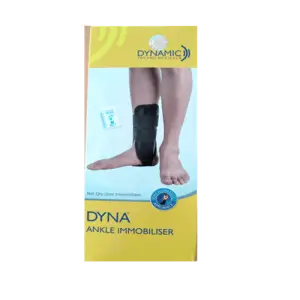

Dyna Ankle Immobilizer: Holds the Joint Still While the First Days Pass
This Dyna ankle immobilizer stops the ankle moving, so a badly injured joint is protected from the twist or the knock that would set it back during the days when it is at its most vulnerable. It is the firmest support on this shelf, and it is what our doctor reaches for after a severe sprain, after a fracture has been cleared, and after some operations on the foot and ankle.
It is a padded wrap-around splint in a soft outer shell, fastened with broad straps you can set yourself, light enough to sleep in and open enough to look at the skin without undoing everything. It is the dearest ankle product we keep, and for most sprains it is more support than the injury needs, which is why our pharmacist will ask what happened before selling you one.
Please Read This Before You Buy One
Most ankle sprains should not be immobilised at all. The evidence runs the other way round: functional support and getting the joint moving give better results than strapping it still. Where immobilisation is used for pain or swelling, the guidance puts the limit at no more than about 10 days, after which functional treatment should start, and functional support for four to six weeks is what is preferred overall.
So this is a short-term device with a job and an end date. An ankle held still for weeks stiffens, the calf wastes, and the balance that stops you turning it again goes with it. A customer who buys this and wears it for a month will have a worse ankle in six weeks than one who wore a brace and walked.
Which is why this is the one product on this shelf that should not be bought without our doctor. Come in, let us look at the ankle, and let us tell you whether you want this, a brace, or neither.
When an Immobilizer Is the Right Answer
After a severe sprain where the joint is unstable, for the first days, under instruction, with a plan for coming out of it.
After a fracture has been seen and cleared for this kind of support, or as a step down from a cast.
After surgery to the foot or ankle, where the surgical team has specified it.
Where somebody has to be moved, transported or taken to hospital and the ankle needs protecting on the way.
Outside those, a lace-up ankle brace gives sideways control while letting you walk, which is what most sprained ankles actually want, and for mild swelling and aching an adjustable ankle support is enough.
Wearing It
Put it on sitting down with the foot at a right angle, not pointed. The angle it sets in is the angle it holds, and an ankle held pointing down tightens the calf in a way that takes weeks to undo.
A sock underneath, plain and seam-free, keeps the skin comfortable and the lining clean.
Fasten the straps from the bottom upwards, firm and even. Then check your toes: press a nail and watch the colour come back. Pins and needles, numbness, a bluish or very pale colour, coldness, or pain getting worse mean too tight, so loosen the straps and check again.
Look at the skin at least once a day, over the ankle bones, the heel and the top of the foot. A red mark that stays red when you press it is the early sign of pressure damage, and it needs the strapping adjusted and our doctor told. Keep the lining dry, and wipe the shell rather than soaking it.
Coming Out of It
This is the part people are never told, and it is where the outcome is decided.
Come out of it when our doctor says, not when it feels comfortable, and step down into a brace or a support rather than straight into nothing.
Then get the ankle moving. Gentle range of movement first, then weight through it as pain allows, then balance work: standing on the injured leg for thirty seconds at a time, several times a day, holding a worktop at first and then letting go. That balance training is what most reduces the chance of turning the ankle again.
Expect the ankle to feel odd and the calf to feel weak for the first week out of it. That settles with use. Our doctor will set out the stages, or point you to a physiotherapist, and our pharmacist will size the Kedley advanced ankle support or the lace-up brace you step down into.
Is an Ankle Immobilizer Right for You?
An immobilizer suits severe injuries, under instruction. Please speak to our doctor before buying one if any of these apply:
- Nobody has examined the ankle. Please see our doctor first. The question of whether a bone is broken comes before the question of which support to buy, and this is an expensive way to get that order wrong.
- You have an ordinary sprain and can walk on it. This is more support than you need and more than is good for you, and our pharmacist will say so and sell you a brace instead.
- You have diabetes, poor circulation or numbness in the foot. A rigid support that cannot be felt pressing is a real risk, and the skin must be checked daily by somebody who knows what to look for.
- There is swelling in the calf, with pain or warmth, or you are short of breath. Please go to a hospital rather than strapping the leg, because a clot after an ankle injury is a medical emergency.
- It is for a child. Children’s ankle injuries behave differently and growth plates are involved. Our doctor should see any child who has hurt an ankle badly enough to consider this.
Our pharmacists will fit it and show you the toe and skin checks, and our doctor will tell you when to come out of it and what to step down into.
Where to Buy an Ankle Immobilizer in Kenya
Order online and we deliver countrywide, or collect from our pharmacy at Kahawa Sukari Shopping Center, Nairobi. We send orders to Nairobi and every neighbourhood around it — the CBD, Westlands, Parklands, Gigiri, Muthaiga, Runda, Rosslyn, Kitisuru, Lower Kabete, Lavington, Kileleshwa, Kilimani, Karen, Langata, South B, South C, Eastleigh, Buruburu, Donholm, Embakasi, Ngong Road, Kasarani, Roysambu, Zimmerman, Githurai, Ruaka, Banana Hill, Two Rivers, Village Market and Pride Lands — and across Kiambu, Thika, Juja, Ruiru, Kikuyu, Limuru and Ngong.
Beyond the capital we deliver to Mombasa, Kisumu, Nakuru, Eldoret, Nyeri, Machakos, Athi River, Kitengela, Kajiado, Naivasha, Narok, Kericho, Bomet, Kisii, Migori, Homa Bay, Siaya, Bungoma, Busia, Kakamega, Vihiga, Webuye, Kitale, Nandi Hills, Iten, Kapenguria, Embu, Meru, Chuka, Kerugoya, Murang’a, Othaya, Nyahururu, Nanyuki, Maralal, Isiolo, Marsabit, Moyale, Wajir, Mandera, Garissa, Lodwar, Kitui, Mwingi, Makueni, Emali, Kibwezi, Voi, Taveta, Wundanyi, Mariakani, Diani, Ukunda, Kilifi, Watamu, Malindi, Lamu and Hola. Please speak to our doctor before ordering this one, and tell us what happened to the ankle.
Across Africa, ask us before you order. We have sent orders to Uganda, Tanzania, Somaliland and as far as Malawi, and we will quote for Rwanda, Burundi, South Sudan, Ethiopia, Zambia, Zimbabwe, Botswana, Mozambique, Nigeria, Ghana, South Africa and the rest of the continent. Tell us the destination and we will confirm any import paperwork before the parcel leaves us.
Living abroad? Order from wherever you are and we deliver here in Kenya. Kenyans in the UK, the United States, Canada, South Africa and the Gulf order from us regularly for a parent or relative at home, and this is one of the things they order most. Tell us the address and we will deliver and set it up.
Why Buy Your an Ankle Immobilizer from HealthAlone Kenya?
HealthAlone is a pharmacist-led health ecosystem licensed by the Pharmacy and Poisons Board, and our stock is original, sealed and correctly stored. Kahawa Sukari is a real counter with real pharmacists behind it.
This is the one product on this shelf that should not be bought without being examined first. Our doctor will tell you whether you want an immobilizer, a brace, or neither, and when to come out of it.
It is one more step in our vision: building Africa’s most trusted health ecosystem, accessible to everyone, everywhere.
FAQs
Should I immobilise a sprained ankle?
Usually not. Functional support and getting the joint moving give better results than holding it still. Where immobilisation is used for pain or swelling, the guidance puts the limit at no more than about 10 days, after which functional treatment should start, and functional support for four to six weeks is what is preferred overall. Please let our doctor decide which your ankle needs.
When is an immobilizer the right choice?
After a severe sprain where the joint is unstable, after a fracture has been seen and cleared for this kind of support or as a step down from a cast, after surgery to the foot or ankle, and where somebody has to be moved or transported with the ankle protected. Outside those, a brace is usually the better answer.
How long should I wear it?
As long as our doctor says, and no longer. An ankle held still for weeks stiffens, the calf wastes and the balance that stops you turning it again goes with it. Coming out of it on time matters as much as putting it on.
What angle should my foot be in?
At a right angle, not pointed. Put it on sitting down and set the foot square first. The angle it holds is the angle it sets in, and an ankle held pointing down tightens the calf in a way that takes weeks to undo.
How tight should the straps be?
Firm and even, fastened from the bottom upwards. Then press a toenail and watch the colour come back. Pins and needles, numbness, a bluish or very pale colour, coldness, or pain getting worse all mean too tight, so loosen the straps and check again.
Can I sleep in it?
It is light enough to sleep in and our doctor will tell you whether you should. Some injuries want it on overnight and others do not, and that depends on the injury rather than on the device.
Can I walk in it?
Only as our doctor has told you, and with whatever walking aid we have given you. Weight-bearing after an ankle injury is a clinical decision, and this device is bought by people who have been told how much weight to put through the leg.
What should I check on the skin?
Look at least once a day over the ankle bones, the heel and the top of the foot. A red mark that stays red when you press it is the early sign of pressure damage and needs the s