

What Turmeric Cinnamon Tea Gives You
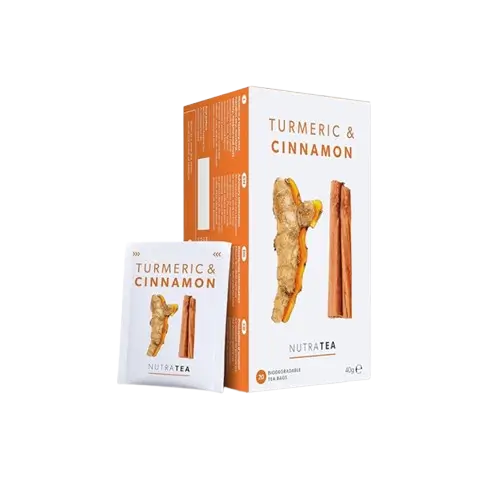
Turmeric cinnamon tea keeps you on Ceylon cinnamon, the low-coumarin species, rather than the Cassia that most cinnamon products use, blended 30% with 70% turmeric root across 20 biodegradable bags.
That is a genuine distinction and almost nobody selling cinnamon explains it, so we will. The two cinnamons are different plants, they differ enormously in one compound, and which one is in your cup decides how much of it is sensible to drink every day. This box says Cinnamomum verum on it, which is the good news, and that one word on a box is worth paying for.
Ceylon, Cassia, and the Compound That Separates Them
Cassia cinnamon contains a lot of coumarin. Ceylon cinnamon contains very little. Coumarin is a naturally occurring compound, and Germany’s federal risk assessment institute set a tolerable daily intake for it of 0.1 mg per kilogram of body weight — about 6 mg a day for a 60 kg adult. The European Food Safety Authority arrived at the same figure.
The gap between the two cinnamons is wide. Cassia averages around 3,000 mg of coumarin per kilogram, with measured samples as high as 10,000 mg per kilogram. Ceylon carries only low levels.
What that means in practice. The concern with sustained high coumarin intake is the liver: in a small number of especially sensitive people, medicinal doses raised liver enzymes, and in severe cases caused liver inflammation. The German institute’s own guidance is that anybody using large amounts of cinnamon regularly should use Ceylon instead of Cassia, and that Cassia should be consumed in moderation.
So the Ceylon label on this box is the reason to buy it. If cinnamon is something you want daily rather than occasionally, the species matters more than the brand, and most of what is sold simply as “cinnamon” is Cassia.
What Is in a Box of Turmeric Cinnamon Tea
Turmeric root, about 70% of the blend. Curcuma longa, ground root rather than an extract.
Ceylon cinnamon bark, about 30%. Cinnamomum verum, named on the box, which is the whole point above.
20 biodegradable bags, up to 40 cups. Nothing added: no sweeteners, no flavourings, no caffeine. Vegan, vegetarian and kosher, and free from gluten, wheat, soya and dairy.
Ground root rather than an extract, which is worth understanding before you compare it with a capsule. A turmeric capsule usually contains a standardised curcumin extract at a stated milligram figure. This is the whole ground root infused in water, and the box quantifies neither the curcumin nor the cinnamaldehyde. We would rather tell you that plainly than print the phrase “effective levels” over a number nobody has published. Treat it as a good cup of tea made from two real botanicals, which is what it is.
How to Brew It
200 ml of freshly boiled water, steeped 4 to 5 minutes, then squeeze the bag gently. Turmeric is not a fast infuser, so the full five minutes is worth the wait and the squeeze does more here than with a leaf tea.
Two or three cups a day is the figure on the box and we would stay inside it. A splash of plant milk softens the turmeric considerably if you find it earthy, and a little honey works without turning it into a dessert.
Turmeric stains, and it is worth a warning nobody gives. It will mark a light worktop, a wooden spoon and the inside of a pale mug, so rinse rather than letting a cup stand overnight. A squeeze of lemon lifts the colour out of most surfaces if you catch it early.
What We Will Not Claim for It
This matters more on this product than on most, so we would rather set it out than leave it implied.
No approved health claim exists anywhere in the European register for turmeric, for curcumin or for cinnamon. Not for joints, not for inflammation, not for blood sugar, not for cholesterol, not for the liver, not as an antioxidant. Plant claims as a category have never been assessed, so a shop may not print a benefit beside a herb, and we will not.
The blood sugar one deserves a sentence of its own, because it is the claim most often made for cinnamon and the one that can do the most harm. If you manage type 2 diabetes, please keep taking exactly what you have been prescribed and treat this as a nice cup of tea. Our doctor is at the pharmacy if you want your treatment reviewed properly, and that is a different conversation from a tea box.
What we can tell you honestly is the Ceylon point above, the blend, the brewing and the fact that it tastes good. On a shelf full of boxes making promises, that is a better offer than it looks.
If turmeric is specifically what interests you, a turmeric infusion with black pepper added is the other turmeric tea we carry, and the pepper is there for a reason that page explains. For something sharper, a cherry and nettle infusion is at the other end of our range, and a half-and-half lemongrass and ginger tea is the one most people reach for daily.
Is Turmeric Cinnamon Tea Right for You?
- If you manage diabetes, please read the paragraph above. Cinnamon is widely claimed to act on blood sugar and no approved claim supports it. Keep taking your prescribed medicines, and let our doctor review your treatment rather than a tea.
- If you take a blood thinner, or you have surgery or dental work booked. Turmeric in quantity is worth raising with whoever manages your anticoagulant. Bring your prescription to the counter.
- If you have gallstones or a bile duct problem. Turmeric is one to ask our pharmacist about before you make it a daily habit.
- If you are pregnant or breastfeeding. Turmeric and cinnamon in cooking amounts are ordinary foods; two or three strong cups a day is more than that, so please ask us first.
- If you have a liver condition. Please speak to our doctor before a daily habit. The Ceylon species is the right starting point, and your own situation still comes first.
Where to Buy Turmeric & Ceylon Cinnamon Nutra Tea in Kenya
Order online and we deliver countrywide, or collect from our pharmacy at Kahawa Sukari Shopping Center, Nairobi. We send orders to Nairobi and every neighbourhood around it — the CBD, Westlands, Parklands, Gigiri, Muthaiga, Runda, Rosslyn, Kitisuru, Lower Kabete, Lavington, Kileleshwa, Kilimani, Karen, Langata, South B, South C, Eastleigh, Buruburu, Donholm, Embakasi, Ngong Road, Kasarani, Roysambu, Zimmerman, Githurai, Ruaka, Banana Hill, Two Rivers, Village Market and Pride Lands — and across Kiambu, Thika, Juja, Ruiru, Kikuyu, Limuru and Ngong.
Beyond the capital we deliver to Mombasa, Kisumu, Nakuru, Eldoret, Nyeri, Machakos, Athi River, Kitengela, Kajiado, Naivasha, Narok, Kericho, Bomet, Kisii, Migori, Homa Bay, Siaya, Bungoma, Busia, Kakamega, Vihiga, Webuye, Kitale, Nandi Hills, Iten, Kapenguria, Embu, Meru, Chuka, Kerugoya, Murang’a, Othaya, Nyahururu, Nanyuki, Maralal, Isiolo, Marsabit, Moyale, Wajir, Mandera, Garissa, Lodwar, Kitui, Mwingi, Makueni, Emali, Kibwezi, Voi, Taveta, Wundanyi, Mariakani, Diani, Ukunda, Kilifi, Watamu, Malindi, Lamu and Hola. At two or three cups a day a pack runs for a known length of time, so tell us the pack size you want and we will work out how many months that covers before you order.
Across Africa, ask us before you order. We have sent orders to Uganda, Tanzania, Somaliland and as far as Malawi, and we will quote for Rwanda, Burundi, South Sudan, Ethiopia, Zambia, Zimbabwe, Botswana, Mozambique, Nigeria, Ghana, South Africa and the rest of the continent. Tell us the destination and we will confirm any import paperwork before the parcel leaves us.
Living abroad? Order from wherever you are and we deliver to your family here in Kenya. Kenyans in the UK, the United States, Canada, South Africa and the Gulf order from us regularly for parents and relatives at home. A herbal tea like this one taken steadily month after month does far more than a single pack, so tell us who it is for and how many months you want covered and we will set up the repeat.
Why Buy Your Turmeric & Ceylon Cinnamon Nutra Tea from HealthAlone Kenya?
HealthAlone is a pharmacist-led health ecosystem licensed by the Pharmacy and Poisons Board, and our stock is original, sealed and correctly stored. Kahawa Sukari is a real counter with real pharmacists behind it.
Our pharmacists will tell you the difference between Ceylon and Cassia cinnamon, and be straight about what a herbal tea can and cannot do for you. Our doctor is here too if you would rather have the whole question looked at properly.
It is one more step in our vision: building Africa’s most trusted health ecosystem, accessible to everyone, everywhere.
Frequently Asked Questions
Is the cinnamon Ceylon or Cassia, and why does it matter?
Ceylon — Cinnamomum verum — and it is the best thing about this box. The two cinnamons are different plants and differ enormously in a compound called coumarin: Cassia averages around 3,000 mg per kilogram and has been measured as high as 10,000, while Ceylon carries only low levels. The tolerable daily intake set for coumarin is 0.1 mg per kilogram of body weight, about 6 mg a day for a 60 kg adult, so the species decides how much cinnamon is sensible daily. Most cinnamon sold simply as “cinnamon” is Cassia.
What does turmeric cinnamon tea do?
The straight answer is that no approved health claim exists in the European register for turmeric, curcumin or cinnamon — not for joints, inflammation, blood sugar, cholesterol, the liver or antioxidant activity. Plant claims as a category have never been assessed. So we sell this as a good caffeine-free infusion made with the better cinnamon species, and nothing more. If you want help with something specific, please ask our pharmacist.
Will it help my blood sugar or my diabetes?
No, and this is the one question we want to answer plainly. Cinnamon is widely claimed to act on blood sugar and no approved claim supports it. If you manage type 2 diabetes, please keep taking exactly what you have been prescribed and enjoy this as tea. Our doctor is at the pharmacy if you would like your treatment reviewed properly.
Will it help my cholesterol or blood pressure?
No approved claim exists for cinnamon on either. If cholesterol is your reason for shopping, ask our pharmacist — there is an ingredient on our shelves that does hold a current approved cholesterol claim, and we would rather point you at it than sell you a tea.
Can I take it with my medication?
Bring your list to the counter rather than assuming either way. The ones worth checking are blood thinners, since turmeric in quantity is worth raising with whoever manages your anticoagulant, and anything for diabetes. Tell your surgeon or dentist too if you have a procedure booked.
Is it safe to drink every day?
For most people, at the two or three cups on the box, yes — and the Ceylon cinnamon is exactly why we can say that about a daily habit. The exceptions are above: diabetes, blood thinners, gallstones or a bile duct problem, pregnancy and breastfeeding, and any liver condition. Please have that conversation with us before you start.
How much curcumin is in a cup?
Not stated, and we will not estimate it. The box gives the blend as roughly 70% turmeric root and 30% Ceylon cinnamon bark without quantifying curcumin or cinnamaldehyde, so any figure we gave you would be invented. It is ground root in a tea bag rather than a standardised extract, which is worth knowing when comparing it with a capsule.
How do I brew it properly?
200 ml of freshly boiled water, a full 4 to 5 minutes, then squeeze the bag. Turmeric infuses slowly, so cutting the time short is what makes a weak cup. A splash of plant milk softens it if you find the turmeric earthy.
Does it contain caffeine or sugar?
Neither. No sweeteners and no flavourings either — just the two ground botanicals. It is vegan, vegetarian and kosher, and free from gluten, wheat, soya and dairy.
How is this different from your other turmeric tea?
This one pairs turmeric with Ceylon cinnamon. The other turmeric infusion we carry pairs it with black pepper instead, for a reason that page sets out. They are different drinks for different tastes, and our pharmacist will be honest that neither carries an approved health claim.
Where can I buy turmeric cinnamon tea in Kenya, and what does it cost?
From HealthAlone, online for delivery countrywide or over the counter at Kahawa Sukari Shopping Center, Nairobi. The current price is shown at the top of this listing. We deliver across Nairobi — the CBD, Westlands, Parklands, Gigiri, Muthaiga, Runda, Kitisuru, Lavington, Kilimani, Karen, Langata, South B, South C, Eastleigh, Kasarani, Roysambu, Githurai, Ruaka and Banana Hill — and to Kiambu, Thika, Juja, Ruiru, Kikuyu, Limuru, Ngong, Mombasa, Kisumu, Nakuru, Eldoret, Nyeri, Machakos, Kitengela, Naivasha, Narok, Kericho, Kisii, Migori, Homa Bay, Bungoma, Busia, Kakamega, Kitale, Embu, Meru, Nanyuki, Nyahururu, Isiolo, Marsabit, Wajir, Mandera, Garissa, Lodwar, Kitui, Makueni, Voi, Taveta, Mariakani, Diani, Ukunda, Kilifi, Watamu, Malindi and Lamu. Outside Kenya we have delivered to Uganda, Tanzania, Somaliland and Malawi, and we quote for Rwanda, Burundi, South Sudan, Ethiopia, Zambia, Zimbabwe, Nigeria, Ghana, South Africa and the rest of Africa on request. A 20-bag box gives up to 40 cups, so tell us how many boxes you want and we will set up the repeat.
