


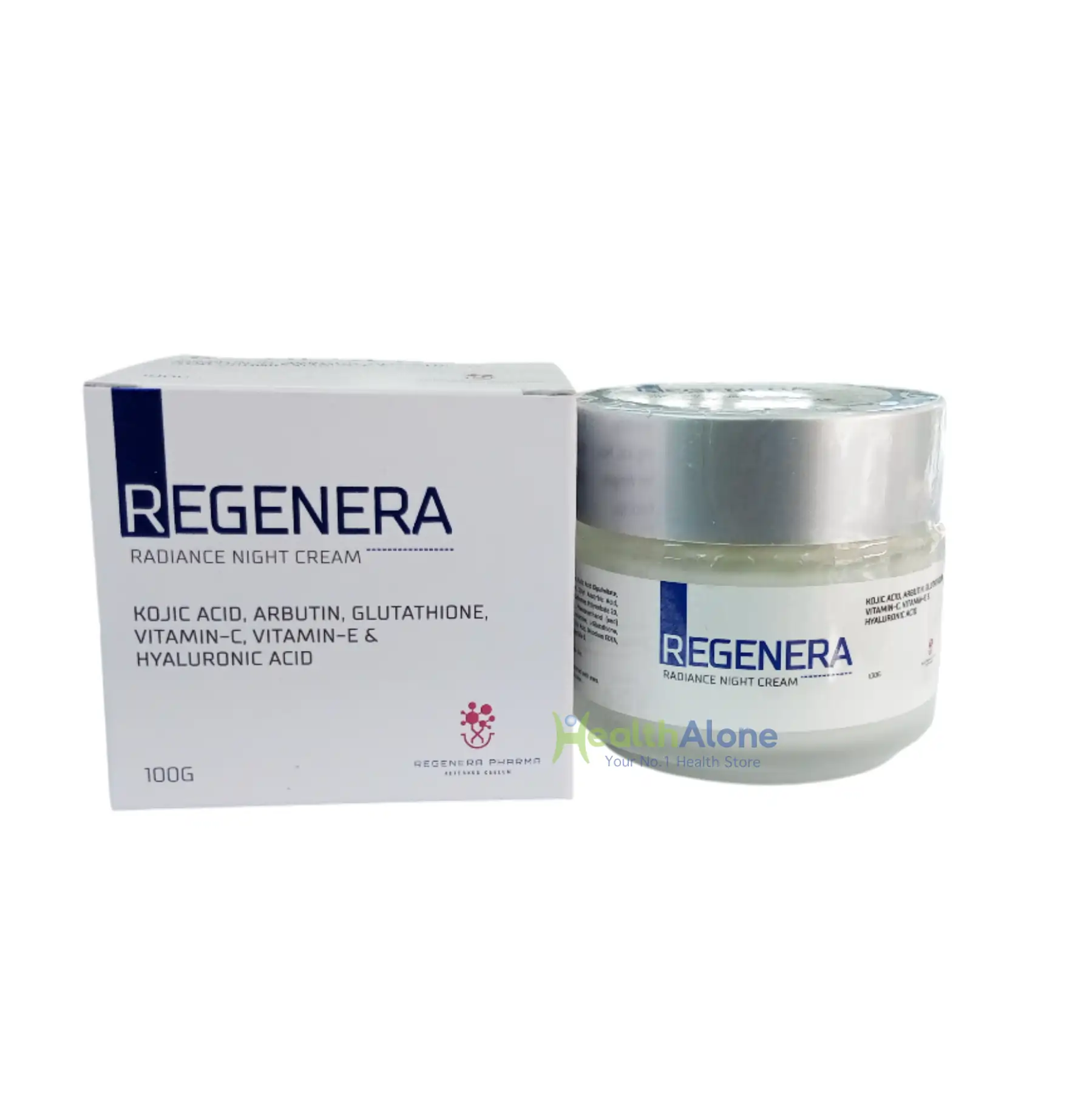
Buy Brightening Night Cream Online in Kenya – Regenera Radiance Night Cream
Regenera Radiance Night Cream is a 100g evening brightening night cream built on kojic acid and alpha-arbutin, with glutathione, vitamin C, vitamin E and hyaluronic acid, applied to a clean face at night.
Brightening means evening out your tone and fading marks — it does not mean changing the colour you are. On that honest definition this is the better-evidenced brightening cream we carry, because kojic acid and alpha-arbutin have real research behind them. It suits uneven tone and the marks left by old spots, and it is a night product for a reason. Sunscreen the next morning is not optional: without it the cream is working against the sun and losing.
What Brightening Actually Means
The word sells two completely different things in this market, and they are worth separating before you spend money.
What this cream does is interfere with melanin production in the patches where your skin is making too much of it. Dark marks left by old spots, shaving bumps or sun exposure fade towards the tone of the skin around them, and the overall effect is more even. What it does not do, and what nothing sold honestly does, is make you a lighter person than you are.
That distinction matters because the products that do promise it exist and are dangerous. Creams containing mercury, unlabelled steroids or illegal hydroquinone levels are sold across this region, and they work quickly enough to convince before they thin the skin and leave permanent patchiness. A cream promising an honest result slowly is the one to trust.
Why This One Has Better Evidence Than Most
Most brightening products rest on thin evidence. This one does not, and that is the reason to choose it.
Kojic acid blocks tyrosinase, the enzyme that makes melanin, and it has been studied in pigmentation for decades. Alpha-arbutin blocks the same enzyme by a different route; it is a plant-derived relative of hydroquinone that releases only a trace of it, which is precisely why it is both effective and permitted in cosmetics where hydroquinone itself is restricted. Used together they act on the same target from two directions, which is the sensible way to treat pigment.
Vitamin C adds a third mechanism and antioxidant protection, while hyaluronic acid and vitamin E keep the formula comfortable — which matters, because an uncomfortable cream is one you stop using in week three.
Glutathione is in here too, and it is the ingredient this market talks about most, so it is worth being straight: applied to the skin it is a much weaker proposition than taken into the body. The molecule is unstable and poorly absorbed through skin, and how much survives in a jar is not well established. It is a useful antioxidant to have in the formula. It is not the reason this cream works — kojic acid and alpha-arbutin are.
Three Weeks Is Not Long Enough to Judge It
Pigment does not move quickly. The mark you can see is melanin held inside skin cells that are already made: blocking the enzyme stops new pigment forming, but the pigment already there has to travel up and shed, and that takes weeks. Expect the first honest signs at six weeks and the real answer at three months. Checking it properly is covered in the first question below.
Sunscreen Is Not Optional With This Cream
Two reasons, and this is the most important thing on the page. First, kojic acid and vitamin C both make skin more sensitive to sun, so the day after is riskier than usual. Second and bigger: ultraviolet light is the signal that tells your skin to make pigment at all. A brightening cream used without daily sunscreen is not less effective — it is wasted, because the cream lifts pigment overnight and an unprotected equatorial day puts it straight back. Kenya sharpens that: we sit on the equator, Nairobi is near eighteen hundred metres, and UVA passes through cloud, matatu windows and office glass.
Broad-spectrum SPF 50 every morning, cloudy days too. If your budget covers only one of the two this month, buy the sunscreen — our Sunfair page is the place to start. We stock both, so we have no reason to steer you either way.
Starting a Brightening Night Cream Without Making Things Worse
On melanin-rich skin, irritation makes pigment — anything that inflames the skin leaves a dark mark outlasting whatever caused it, which is the mechanism behind most of the marks people bring us. That sets a trap for any active cream. Kojic acid irritates a minority of people, and used nightly from the very first night the result can be stinging, flaking and inflammation — which leaves exactly the marks you bought the cream to fade.
So build up. Two or three nights a week for the first fortnight, alternate nights for the next, nightly only after that. Stinging that does not settle within a minute, flaking, or skin that feels tight five minutes after washing all mean you have gone too fast: drop back a step rather than stopping altogether. Going slowly is not the cautious option here, it is the option that works.
The Colour Test on the Jar
A check you can do yourself, at no cost, and reuse on any vitamin C product for life. Vitamin C oxidises in heat and light, and changes colour as it does: fresh is white or pale cream, then yellow, then orange, then brown. Brown means the vitamin C is spent. It will not harm you, but you are no longer getting what you paid for, and a jar that arrived discoloured was stored badly somewhere.
Look at it before you pay, and keep it capped and away from heat and window light. A 100g jar used nightly on face and neck lasts most people three to four months, which is long enough for storage to matter.
How to Use This Brightening Night Cream
The last step happens the following morning.
- Cleanse gently in the evening and pat dry. Not a scrub, not an antiseptic bar, not hot water — stripping the skin first makes an active cream sting
- A small amount over face and neck, avoiding the eyelids and the corners of the nose. More does not fade anything faster and reliably irritates
- Two or three nights a week to begin with, building to alternate nights and then, if your skin stays comfortable, to nightly
- A plain moisturiser afterwards if your skin is dry. Nothing else active on the same night — no retinol, no acid exfoliant, no second vitamin C
- Sunscreen the next morning, without exception. This is the step that decides whether the other four were worth doing
Which Brightening Product Do You Actually Need?
We carry several and they are not interchangeable.
This cream is the intensive evening treatment for uneven tone and marks already there. Our Regenera Collagen Day Cream is the morning product in the same range, built for hydration rather than pigment, so the two work as a routine rather than as a matched pair. A daily sunscreen is what stops new marks forming and belongs in any brightening routine before either cream. If your concern is one stubborn patch rather than general unevenness, ask us — this may not be the right product.
Who Should See a Doctor Instead
Some patterns are not a cosmetic problem, and we would rather say so than sell you a jar. If your dark patches are symmetrical across both cheeks, the forehead and the upper lip, and darken every time you are in the sun, that pattern suggests melasma, which needs a doctor and strict sun protection rather than an over-the-counter cream. If any patch is growing, changing shape or colour, bleeding, itching persistently or has an irregular border, do not treat it with anything — see a doctor.
If you are pregnant or breastfeeding, ask our pharmacist first. And if your skin is broken, freshly waxed, sunburnt or inflamed, wait until it has settled.
Why Buy Your Brightening Night Cream from HealthAlone Kenya?
HealthAlone is a pharmacist-led health ecosystem licensed by the Pharmacy and Poisons Board, and our stock is original, sealed and correctly stored. Brightening is the category where that matters most: it is where counterfeits containing mercury and unlabelled steroids turn up, and vitamin C degrades in heat and light, so where a jar has been kept is part of what you buy. You can also just ask — bring us what you are using now, or a photograph of the labels, and our pharmacist will tell you whether they work together and whether this cream suits the marks you actually have.
We deliver across Kenya — Nairobi first, then Mombasa, Kisumu, Nakuru, Eldoret, Thika and beyond — and across East Africa to Tanzania and Uganda, with the wider African market where we are heading. Collect in person at Kahawa Sukari Shopping Center, Nairobi. Living abroad? Order online from the US or UK and we deliver to your family in Kenya.
It is one more step in our vision: building Africa’s most trusted health ecosystem, accessible to everyone, everywhere.
Frequently Asked Questions
How long before I see a difference?
Six weeks for the first honest signs and three months for the real answer. Pigment already sitting in the skin has to travel up and shed before a mark fades, and that takes time no cream can shorten. Take a photograph in daylight on the day you start and compare it against the same lighting six weeks later, because mirror comparisons each morning will show you nothing.
Will it lighten my skin?
No, and it is not meant to. It evens your tone and fades marks towards the colour of the skin around them. Any product promising to change your natural colour is the kind to be suspicious of — that is where mercury, unlabelled steroids and illegal hydroquinone levels turn up, and those work quickly before they do lasting damage.
Is this the best night cream for hyperpigmentation?
It is a strong choice for general unevenness and for marks left by old spots and sun exposure, because kojic acid and alpha-arbutin have better evidence than most brightening ingredients. For a single stubborn patch, or for melasma, it is not the right tool — those need either a more targeted product or a doctor. Tell our pharmacist what your marks look like and how long you have had them and you will get a straight answer.
Is this an eflornithine cream?
No, and the two are not related. Eflornithine slows unwanted facial hair growth and does nothing for pigmentation, while this cream works on tone and marks and does nothing for hair. We stock eflornithine separately — ask our pharmacist or search for it on this site rather than buying this by mistake, because neither product does the other one’s job.
Do I really have to wear sunscreen with it?
Yes, and it is the difference between the cream working and the cream being wasted. Kojic acid and vitamin C both raise sun sensitivity, so the day after is riskier than usual. More importantly, ultraviolet light is what tells your skin to make pigment, so an unprotected day undoes the night before. Broad-spectrum SPF 50, every morning, cloudy days included.
Can I use it with my vitamin C serum or a retinol cream?
Not on the same night. This cream already contains vitamin C, and stacking another one on top gives no extra benefit and a good chance of irritation. With retinol, alternate them — this cream one night, retinol the next. Layering actives is where most home routines go wrong and where the irritation that causes new marks comes from.
Can I use it in the morning?
No, evening only. The actives raise sun sensitivity and vitamin C degrades in light and heat, so a morning application gets you the risk without the benefit. Mornings belong to sunscreen.
Is it suitable for sensitive skin?
Often, but patch test first — behind the ear or on the inner forearm, twice a day for two days. Kojic acid causes contact irritation in a minority of people, and on melanin-rich skin irritation leaves marks of its own, which is the opposite of what you want. Start on two or three nights a week rather than nightly, whatever your skin type.
Can I use it with the Collagen Day Cream?
Yes, and they work well together, but they are different formulations rather than a matched pair. The day cream is built around hydration and comfort; this one is built around pigment. Morning: day cream, then sunscreen. Evening: this. If you only want one, choose by which problem bothers you more.
Where can I buy brightening night cream in Kenya?
Order online from HealthAlone for delivery in Nairobi, Mombasa, Kisumu, Nakuru, Eldoret, Thika and beyond, and across East Africa to Tanzania and Uganda. You can also collect in person at Kahawa Sukari Shopping Center, Nairobi, where a pharmacist will look at the jar with you and tell you honestly whether it is the right one for your marks.

