

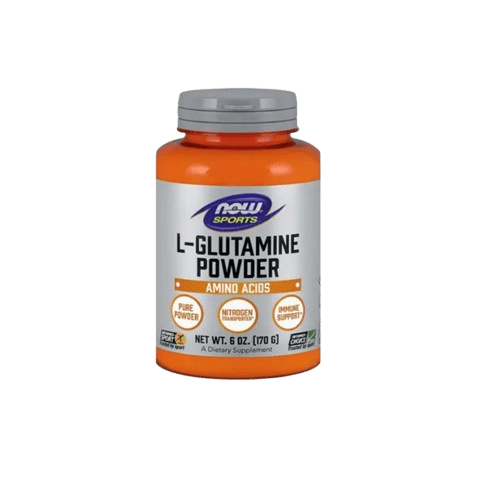
L-Glutamine Powder 170g
L-glutamine is the amino acid that fuels the cells lining your gut, and this powder is taken to help support the intestinal lining, immune function and recovery after hard training or illness.
Glutamine is the most plentiful amino acid in the body and normally you make all you need. Demand rises above supply in specific situations — serious illness, surgery, burns, heavy training blocks — and those are the situations where a supplement earns its place. Knowing which situation you are in is most of the decision, and one of them needs a doctor rather than a tub.
The cells lining the small intestine burn glutamine as their preferred fuel, which is why it is associated with the gut lining rather than with muscle. Immune cells use it heavily too, and demand climbs when they are working hard.
Under ordinary conditions your body makes enough, mostly in skeletal muscle, and food supplies more. It is classed as conditionally essential for that reason: enough in normal life, not always enough under stress.
If You Have Sickle Cell Disease, Read This Before You Buy
L-glutamine is a licensed medicine for sickle cell disease, and it is not this tub. A pharmaceutical-grade oral powder is approved to reduce acute complications of sickle cell disease in adults and children from five years old, and a phase three trial found fewer pain crises and fewer hospital admissions.
The treatment dose is weight-based and much larger than a supplement scoop. Under 30 kilograms it is 5 grams twice a day; between 30 and 65 kilograms, 10 grams twice a day; above 65 kilograms, 15 grams twice a day. At the adult dose a 170 gram tub would last under six days.
Treating sickle cell disease is a decision for a haematologist or your treating doctor, alongside hydroxyurea and everything else in the plan, with monitoring. Speak to our doctor or your clinic rather than starting on a general supplement. Our pharmacist can also tell you what is available in Kenya at treatment strength.
What It Is Reasonable to Expect Otherwise
Recovery after surgery, burns or serious illness is where the evidence is oldest and clearest, because that is when the body’s demand outruns what it can make.
Gut symptoms. Glutamine feeds the intestinal lining, and small studies in irritable bowel syndrome after an infection have been encouraging. The wider claim about repairing a leaky gut runs ahead of the evidence, and anyone with persistent bowel symptoms should be assessed rather than self-treating.
Training. Useful during heavy blocks, long endurance work or a calorie deficit, when demand is genuinely raised. For an average gym session it adds little that protein in food does not, and it does not build muscle directly.
Mouth ulcers during chemotherapy are a recognised use, but that belongs with the oncology team rather than with a shop purchase.
How to Take It
One rounded teaspoon, five grams, in water or juice, between meals, once or twice a day. The tub holds thirty-four scoops, so seventeen to thirty-four days depending on how you take it.
Mix it fresh and drink it; glutamine is not stable sitting in liquid, and it does not like heat, so never add it to a hot drink or hot food. Give it two to four weeks before judging it.
Who Should Not Take It
Anyone who is seriously ill in hospital should not be given high-dose glutamine without a clinician deciding it. A large intensive care trial found more deaths among critically ill patients with organ failure who received high doses of it. This is not a risk for a healthy person taking a teaspoon, and it is the reason a family member should never take a tub into a ward.
Check with our pharmacist before starting if any of these apply:
- Kidney or liver disease — glutamine carries nitrogen and both organs handle it; safety has not been established where either is impaired.
- Medicine for seizures — the body converts glutamine to glutamate.
- Pregnancy or breastfeeding — there is not enough information to recommend it.
- Cancer treatment under way — there is a place for glutamine in managing mouth ulcers, but it belongs to the oncology team rather than a shop purchase.
Side Effects
At treatment doses the commonest complaints recorded are constipation, nausea, headache and abdominal pain. At a teaspoon or two a day most people notice nothing at all; if you do, it is usually mild stomach upset, and taking it with a little more water between meals settles it.
Stop and speak to us if you get persistent abdominal pain, confusion or unusual drowsiness.
Food, and Whether You Need the Powder
Meat, fish, eggs, milk, beans and cabbage all supply glutamine, and a normal Kenyan diet with reasonable protein covers ordinary needs. If you eat well and train moderately, a tub of this is unlikely to change anything you would notice.
Where it makes sense is a genuine gap: recovering from illness or surgery, eating poorly, training very hard, or a specific gut problem a clinician is managing with you. Ask our pharmacist which of those describes you before you spend three thousand shillings, because in several of them the honest answer is food, and in one of them it is a doctor.
Storing It
Keep the tub tightly closed in a cool dry cupboard, away from steam and direct sun. Scoop with a dry spoon; moisture in the tub clumps the powder and shortens its life. Use it within the period stated on the label once opened.
Where to Buy L-Glutamine Powder in Kenya
Order online and we deliver countrywide, or collect from our pharmacy at Kahawa Sukari Shopping Center, Nairobi. We send orders to Nairobi and every neighbourhood around it — the CBD, Westlands, Parklands, Gigiri, Muthaiga, Runda, Rosslyn, Kitisuru, Lower Kabete, Lavington, Kileleshwa, Kilimani, Karen, Langata, South B, South C, Eastleigh, Buruburu, Donholm, Embakasi, Ngong Road, Kasarani, Roysambu, Zimmerman, Githurai, Ruaka, Banana Hill, Two Rivers, Village Market and Pride Lands — and across Kiambu, Thika, Juja, Ruiru, Kikuyu, Limuru and Ngong.
Beyond the capital we deliver to Mombasa, Kisumu, Nakuru, Eldoret, Nyeri, Machakos, Athi River, Kitengela, Kajiado, Naivasha, Narok, Kericho, Bomet, Kisii, Migori, Homa Bay, Siaya, Bungoma, Busia, Kakamega, Vihiga, Webuye, Kitale, Nandi Hills, Iten, Kapenguria, Embu, Meru, Chuka, Kerugoya, Murang’a, Othaya, Nyahururu, Nanyuki, Maralal, Isiolo, Marsabit, Moyale, Wajir, Mandera, Garissa, Lodwar, Kitui, Mwingi, Makueni, Emali, Kibwezi, Voi, Taveta, Wundanyi, Mariakani, Diani, Ukunda, Kilifi, Watamu, Malindi, Lamu and Hola. Packed to travel, cool-boxed where the weather calls for it, and tracked from our counter to your door.
Across Africa, ask us before you order. We have sent orders to Uganda, Tanzania, Somaliland and as far as Malawi, and we will quote for Rwanda, Burundi, South Sudan, Ethiopia, Zambia, Zimbabwe, Botswana, Mozambique, Nigeria, Ghana, South Africa and the rest of the continent. What we need to know first is your country’s import rules for food supplements and how long the parcel will be in transit; we will tell you plainly if a destination is not worth the shipping cost.
Living abroad? Order from wherever you are and we deliver to your family here in Kenya. Kenyans in the UK, the United States, Canada, South Africa and the Gulf order from us regularly for parents and relatives at home. You pay online from where you live, we deliver to their door anywhere on the list above, and we confirm with you once it has arrived. Give us their name, their phone number and the estate or town they live in, and we will do the rest.
Why Buy Your L-Glutamine Powder from HealthAlone Kenya?
HealthAlone is a pharmacist-led health ecosystem licensed by the Pharmacy and Poisons Board, and our stock is original, sealed and correctly stored.
Tell our pharmacist why you want it. If it is for training, we will tell you honestly whether it is worth the money for the way you train. If it is for a gut problem, for recovery after surgery, or for sickle cell disease, there is a right route for each and only one of them ends at this shelf.
It is one more step in our vision: building Africa’s most trusted health ecosystem, accessible to everyone, everywhere.
Frequently Asked Questions
What is L-glutamine good for?
Its clearest uses are recovery after surgery, burns or serious illness, support for the intestinal lining, and heavy training blocks where demand outruns what the body makes. It is also a licensed medicine for sickle cell disease at much higher, weight-based doses. For everyday health with a decent diet, most people do not need it.
Can L-glutamine help with sickle cell disease?
Yes, and that is a treatment rather than a supplement decision. A pharmaceutical-grade L-glutamine powder is approved to reduce acute complications of sickle cell disease from five years of age, at 5 grams twice daily under 30kg, 10 grams twice daily between 30 and 65kg, and 15 grams twice daily above that. Those doses would empty this tub in under a week. Speak to your haematologist or our doctor rather than starting on a general supplement.
How much should I take?
One rounded teaspoon, five grams, in water or juice between meals, once or twice a day. The 170g tub gives thirty-four scoops, so seventeen to thirty-four days.
Can I take it every day?
At this dose, yes, for a period of weeks to a few months while there is a reason to. It is better used for a purpose and a stretch of time than taken indefinitely out of habit, and if you find you want it permanently that is worth discussing.
Before or after a workout?
Neither matters much. Glutamine is not a pre-workout stimulant and the timing evidence is thin. Between meals, in water, whenever you will remember it, is fine. What it will not do is make you stronger on its own.
Does it fix a leaky gut?
The gut lining does use glutamine as fuel, and small studies in irritable bowel syndrome following an infection have been encouraging. The broader claims made for it go well beyond what has been shown, and persistent bowel symptoms deserve a proper assessment rather than a powder.
Can I mix it into tea or porridge?
Not hot ones. Glutamine breaks down with heat and does not keep in liquid, so mix it into cold or room-temperature water or juice and drink it straight away rather than making it up in advance.
Are there side effects?
At a teaspoon or two most people notice nothing. At the much higher treatment doses, constipation, nausea, headache and stomach pain are the commonest complaints. Mild stomach upset usually settles with more water and taking it between meals.
Is it safe with kidney or liver problems?
Ask first. Glutamine carries nitrogen and both organs are involved in handling it, and safety has not been established where either is impaired. Bring your diagnosis and your medicines to the counter.
Do I need it if I eat well?
Probably not. Meat, fish, eggs, milk, beans and cabbage all provide glutamine, and a normal diet with reasonable protein covers ordinary needs. It earns its place when there is a genuine gap, not as a daily habit alongside good food.
Where can I buy L-glutamine powder in Kenya?
From HealthAlone, online for delivery countrywide or over the counter at Kahawa Sukari Shopping Center, Nairobi. We deliver across Nairobi — the CBD, Westlands, Parklands, Gigiri, Muthaiga, Runda, Kitisuru, Lavington, Kilimani, Karen, Langata, South B, South C, Eastleigh, Kasarani, Roysambu, Githurai, Ruaka and Banana Hill — and to Kiambu, Thika, Juja, Ruiru, Kikuyu, Limuru, Ngong, Mombasa, Kisumu, Nakuru, Eldoret, Nyeri, Machakos, Kitengela, Naivasha, Narok, Kericho, Kisii, Migori, Homa Bay, Bungoma, Busia, Kakamega, Kitale, Embu, Meru, Nanyuki, Nyahururu, Isiolo, Marsabit, Wajir, Mandera, Garissa, Lodwar, Kitui, Makueni, Voi, Taveta, Mariakani, Diani, Ukunda, Kilifi, Watamu, Malindi and Lamu. Outside Kenya we have delivered to Uganda, Tanzania, Somaliland and Malawi, and we quote for Rwanda, Burundi, South Sudan, Ethiopia, Zambia, Nigeria, Ghana, South Africa and the rest of Africa on request.