


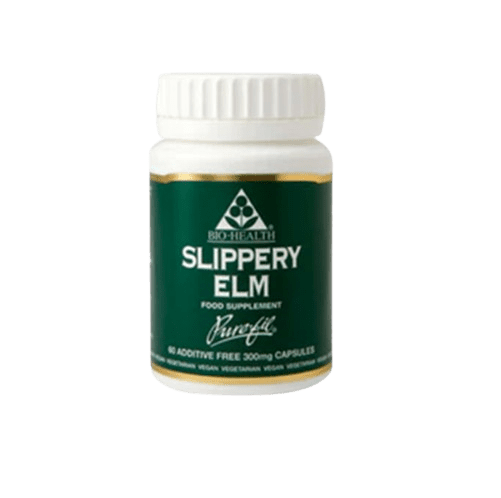
What Slippery Elm Bark Is For
Slippery Elm Bark capsules are what people take for the soreness and irritation of a troubled gut, for heartburn and for the discomfort that comes with a flare of irritable bowel, one capsule up to three times a day before meals. Each capsule carries 300 mg of powdered inner bark of Ulmus rubra, in a vegetable capsule, sixty to the bottle.
Slippery elm works by coating rather than by acting on anything. The inner bark is full of mucilage, a soluble fibre that turns to a thick gel the moment it meets water, and that gel is what lies against an irritated surface. It is the oldest kind of stomach remedy there is and the mechanism is purely physical, which is why it has so few interactions and why the ones it does have are about timing.
Take It With Water, and Keep It Away From Your Other Medicines
Swallow each capsule with a full glass of water and drink more through the day. The mucilage needs water to become a gel at all, and a capsule swallowed dry simply passes through.
And because that gel coats, it can reduce how much of another medicine your gut takes up. So leave one to two hours between slippery elm and anything else you swallow, in either direction. That is the whole of its interaction profile and it is easily managed once you know, but it matters if you take a thyroid tablet, a heart medicine or anything where the dose has been carefully set. Bring us your list and our pharmacist will sort the timing in two minutes.
How the Capsules Compare With the Traditional Way
Worth knowing before you decide, because it sets what to expect. Slippery elm has traditionally been taken as one to three teaspoons of the powder stirred into a glass of water, up to three times a day, which comes to several grams.
Three capsules of this give 900 mg, so the capsules are a convenience rather than the traditional amount. What you gain is that you can carry them, take them at work and swallow them without tasting anything. What you give up is the volume of gel that a glass of the powder produces. For most people with mild irritation that is a fair trade, and if you want the fuller approach, ask our pharmacist and we will tell you what we can get in.
Read This Before Weeks of It: Stomach Pain Needs a Cause
Most peptic ulcers are caused by Helicobacter pylori, a bacterial infection of the stomach, and clearing that infection heals most active ulcers and keeps them from coming back. It is confirmed with a breath test or a stool test and cleared with an acid-reducing medicine plus two or three antibiotics over seven to fourteen days, on prescription.
So a coating herb taken for weeks while an untreated infection carries on soothes the symptom and leaves the cause alone. Come and see our doctor, get the test, and if it is positive have the course prescribed. Slippery elm alongside the course, for the comfort of it, is a sensible thing to take. Our doctor is at the pharmacy and can arrange the test, the prescription and the follow-up test in one visit.
Pregnancy, and the Position Worth Knowing
The reference position on slippery elm in pregnancy is to avoid it, on the basis of possible effects on the womb, and that is firmer than most people expect of a herb this gentle in every other respect.
So if you are pregnant, might be, or are breastfeeding, please come and talk to our doctor rather than starting on your own. Heartburn in pregnancy is extremely common and there are answers that suit it, and our pharmacist will put one in your hand instead. The same conversation covers a child: slippery elm should only be given to a child under our doctor’s direction, and the capsule can be opened into food if swallowing is the difficulty.
One Allergy Note
Slippery elm pollen is a recognised allergen, and the resins of elm species have caused skin reactions on contact. Neither is common from a swallowed capsule, and both are worth mentioning if you react to tree pollens.
Please tell our pharmacist if you have hay fever that flares in spring, or if you have ever reacted to elm, and we will suggest something else. It costs you a sentence at the counter and it saves finding out the hard way.
What We Are Permitted to Tell You
No health claim for slippery elm is authorised, as with every botanical. Every claim submitted in Europe remains on hold, so nobody may lawfully promise you that it relieves irritable bowel, settles reflux or treats gastritis or an ulcer, and we hold back from saying any of it.
What we can give you is the strength, the mechanism, the water it needs, the two-hour gap, how the capsules compare with traditional use, the pregnancy position, the allergy note and the route to a test. What people reach for it for is the soreness, and that is an honest reason to buy a bottle. For a different approach to the same complaint, DGL liquorice is on the same shelf, and Ulcetrol combines a smaller amount of slippery elm with zinc-L-carnosine and mastic gum.
Is Slippery Elm Bark Right for You?
Please talk to our pharmacist or our doctor before you start if any of these apply to you.
- Vomiting blood, or black tarry stools. Go to a hospital now rather than reading further.
- Weight you did not mean to lose, difficulty swallowing, persistent vomiting, or anaemia. Please see our doctor the same day. Those are investigated rather than treated from a shelf.
- Pregnancy, or any chance of it, or breastfeeding. The reference position is to avoid slippery elm in pregnancy. Come and talk to our doctor and we will find you something that suits.
- A child. Only under our doctor’s direction, and the capsule can be opened into food.
- Any medicine where the dose has been carefully set, such as a thyroid tablet or a heart medicine. Keep one to two hours between it and the capsule, and let our pharmacist check the timing.
- Hay fever or a tree pollen allergy. Mention it to us, because slippery elm pollen is a recognised allergen.
Where to Buy Slippery Elm Bark in Kenya
Order online and we deliver countrywide, or collect from our pharmacy at Kahawa Sukari Shopping Center, Nairobi. We send orders to Nairobi and every neighbourhood around it — the CBD, Westlands, Parklands, Gigiri, Muthaiga, Runda, Rosslyn, Kitisuru, Lower Kabete, Lavington, Kileleshwa, Kilimani, Karen, Langata, South B, South C, Eastleigh, Buruburu, Donholm, Embakasi, Ngong Road, Kasarani, Roysambu, Zimmerman, Githurai, Ruaka, Banana Hill, Two Rivers, Village Market and Pride Lands — and across Kiambu, Thika, Juja, Ruiru, Kikuyu, Limuru and Ngong.
Beyond the capital we deliver to Mombasa, Kisumu, Nakuru, Eldoret, Nyeri, Machakos, Athi River, Kitengela, Kajiado, Naivasha, Narok, Kericho, Bomet, Kisii, Migori, Homa Bay, Siaya, Bungoma, Busia, Kakamega, Vihiga, Webuye, Kitale, Nandi Hills, Iten, Kapenguria, Embu, Meru, Chuka, Kerugoya, Murang’a, Othaya, Nyahururu, Nanyuki, Maralal, Isiolo, Marsabit, Moyale, Wajir, Mandera, Garissa, Lodwar, Kitui, Mwingi, Makueni, Emali, Kibwezi, Voi, Taveta, Wundanyi, Mariakani, Diani, Ukunda, Kilifi, Watamu, Malindi, Lamu and Hola. At one to three capsules a day a pack runs for a known length of time, so tell us the pack size you want and we will work out how many months that covers before you order.
Across Africa, ask us before you order. We have sent orders to Uganda, Tanzania, Somaliland and as far as Malawi, and we will quote for Rwanda, Burundi, South Sudan, Ethiopia, Zambia, Zimbabwe, Botswana, Mozambique, Nigeria, Ghana, South Africa and the rest of the continent. Tell us the destination and we will confirm any import paperwork before the parcel leaves us.
Living abroad? Order from wherever you are and we deliver to your family here in Kenya. Kenyans in the UK, the United States, Canada, South Africa and the Gulf order from us regularly for parents and relatives at home. A stomach supplement like this one taken steadily month after month does far more than a single pack, so tell us who it is for and how many months you want covered and we will set up the repeat.
Why Buy Your Slippery Elm Bark from HealthAlone Kenya?
HealthAlone is a pharmacist-led health ecosystem licensed by the Pharmacy and Poisons Board, and our stock is original, sealed and correctly stored. Kahawa Sukari is a real counter with real pharmacists behind it.
Our pharmacists will set the timing against your other medicines, explain why the water matters, and say plainly when a test for Helicobacter pylori and our doctor come first. Our doctor is here too if you would rather have the whole question looked at properly.
It is one more step in our vision: building Africa’s most trusted health ecosystem, accessible to everyone, everywhere.
Slippery Elm Bark: Your Questions Answered
What is in these slippery elm capsules?
300 mg of powdered inner bark of Ulmus rubra in each vegetable capsule, sixty to the bottle, free from gelatin, gluten, dairy and soy.
How does slippery elm work?
By coating rather than by acting on anything. The inner bark is full of mucilage, a soluble fibre that becomes a thick gel the moment it meets water, and that gel lies against an irritated surface.
How many capsules a day?
One capsule up to three times a day, before meals, each with a full glass of water.
Why does the water matter?
Because the mucilage needs water to become a gel at all. A capsule swallowed dry simply passes through, so take each one with a full glass and drink more through the day.
Can I take it with my other medicines?
Leave one to two hours between slippery elm and anything else you swallow, in either direction, because the gel can reduce how much of another medicine you absorb. That is the whole of its interaction profile.
How do the capsules compare with the powder?
Traditionally slippery elm is taken as one to three teaspoons of powder in a glass of water up to three times a day, which comes to several grams. Three capsules give 900 mg. So the capsules are convenience rather than the traditional amount, and for mild irritation that is usually a fair trade.
Can I take it in pregnancy?
The reference position is to avoid slippery elm in pregnancy, on the basis of possible effects on the womb. Please come and talk to our doctor, because heartburn in pregnancy is common and there are answers that suit it.
Can children take it?
Only under our doctor’s direction. If swallowing is the difficulty, the capsule can be opened and the contents mixed into food or a drink.
Will it relieve my IBS?
We are not permitted to tell you that, and nobody else is either. What people reach for it for is the soreness and irritation, and that is an honest reason to try it. If your symptoms have lasted weeks, see our doctor about the cause.
Will it heal an ulcer?
No, and we would rather say so. Most peptic ulcers are caused by Helicobacter pylori, and clearing that infection with prescription antibiotics is what heals most active ulcers. Come and see our doctor for the test.
Can I take it long term?
People do take it steadily, and the mechanism is physical rather than pharmacological. But needing something daily for weeks is itself the signal to come and find out why, rather than to buy a second bottle.
I have hay fever. Is that a problem?
Worth mentioning. Slippery elm pollen is a recognised allergen and elm resins have caused skin reactions on contact. Neither is common from a swallowed capsule, but tell us and we will suggest something else if you prefer.
When should I see a doctor rather than buy a supplement?
Vomiting blood or black tarry stools means going to hospital now. Unintended weight loss, difficulty swallowing, persistent vomiting or anaemia means seeing our doctor the same day.
Where can I buy Slippery Elm Bark 60s in Kenya, and what does it cost?
From HealthAlone, online for delivery countrywide or over the counter at Kahawa Sukari Shopping Center, Nairobi. The current price is shown above. We deliver across Nairobi — the CBD, Westlands, Parklands, Gigiri, Muthaiga, Runda, Kitisuru, Lavington, Kilimani, Karen, Langata, South B, South C, Eastleigh, Kasarani, Roysambu, Githurai, Ruaka and Banana Hill — and to Kiambu, Thika, Juja, Ruiru, Kikuyu, Limuru, Ngong, Mombasa, Kisumu, Nakuru, Eldoret, Nyeri, Machakos, Kitengela, Naivasha, Narok, Kericho, Kisii, Migori, Homa Bay, Bungoma, Busia, Kakamega, Kitale, Embu, Meru, Nanyuki, Nyahururu, Isiolo, Marsabit, Wajir, Mandera, Garissa, Lodwar, Kitui, Makueni, Voi, Taveta, Mariakani, Diani, Ukunda, Kilifi, Watamu, Malindi and Lamu. Outside Kenya we have delivered to Uganda, Tanzania, Somaliland and Malawi, and we quote for Rwanda, Burundi, South Sudan, Ethiopia, Zambia, Zimbabwe, Nigeria, Ghana, South Africa and the rest of Africa on request. At one to three capsules a day a bottle of sixty runs three weeks to two months, so tell us how long you want covered.